Understanding the People’s Council, Kazakhstan’s new advisory body

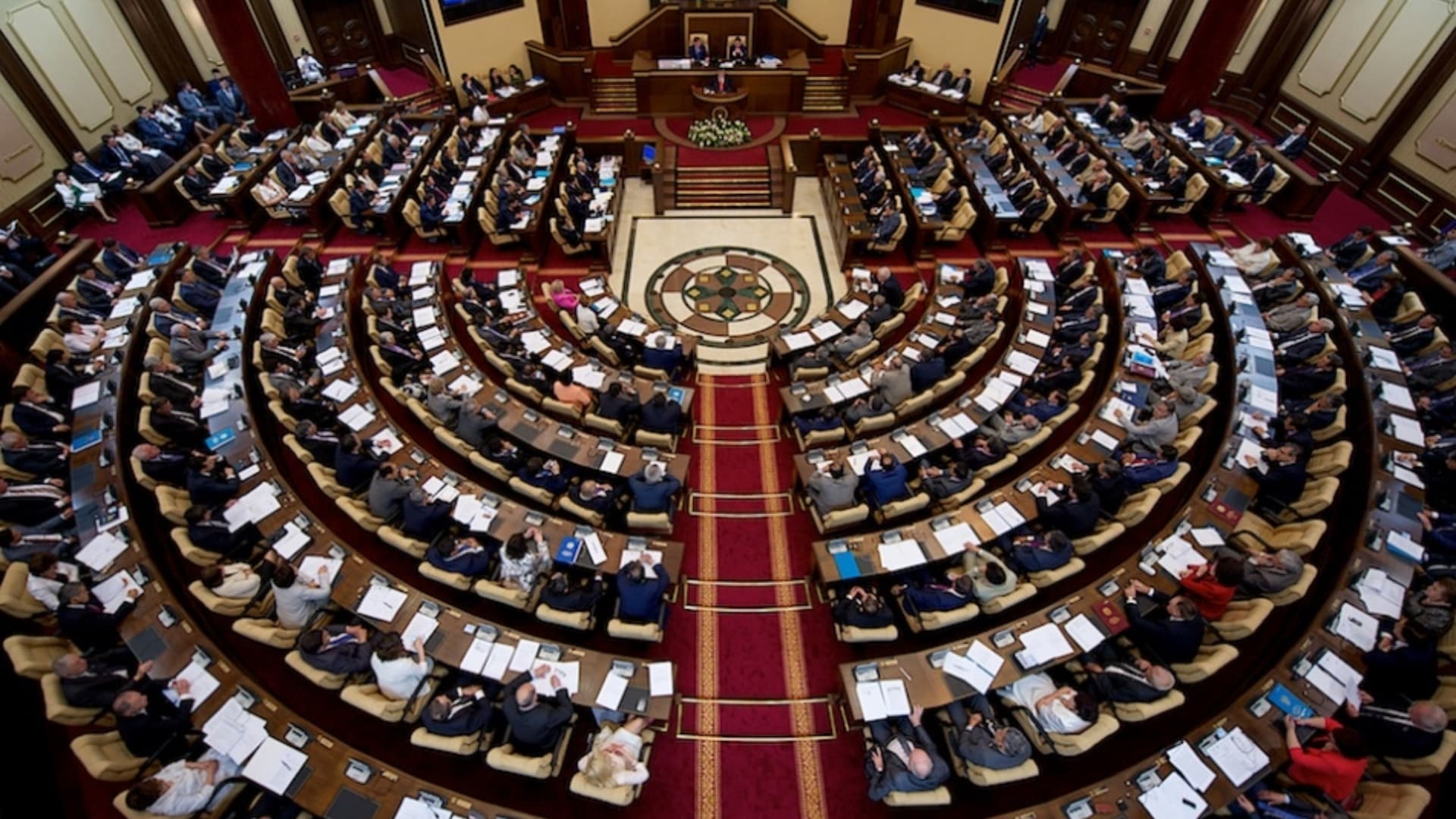
On June 5, 2026, Kazakhstan adopted the Constitutional Law on the People’s Council of Kazakhstan, creating a new constitutional body that replaces the Assembly of the People of Kazakhstan, whose governing law has been repealed.
What is the People’s Council?
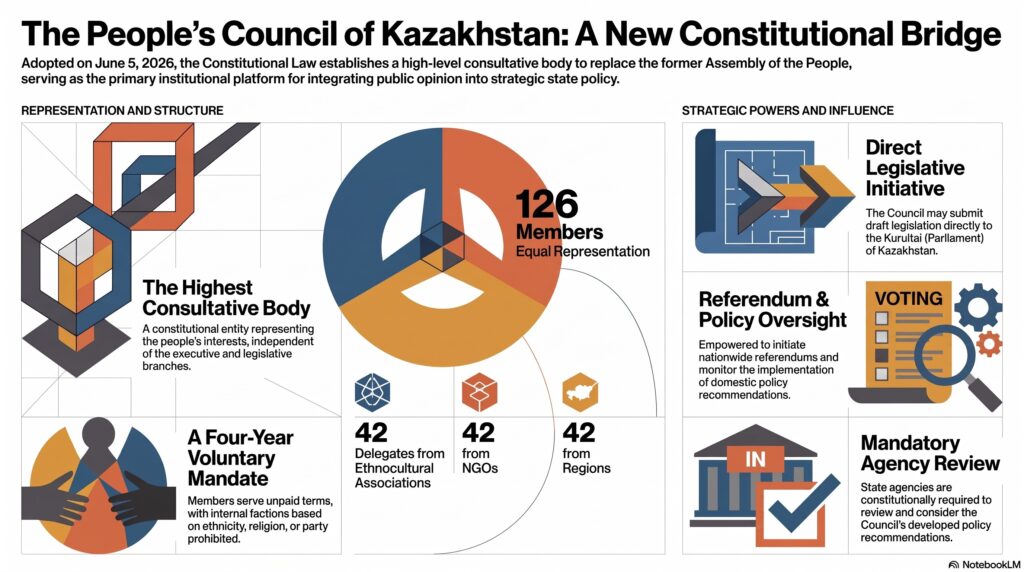
The People’s Council (Halyk Kenesi) of Kazakhstan is the country’s highest constitutional consultative body representing the interests of the people. It is not part of the executive or legislative branches of government but holds a prominent political and legal status.
The Council serves as the government’s primary institutional platform for dialogue with society, providing a formal mechanism for incorporating public opinion into the development of strategically important state policies and decisions.
Notably, from 2022 until the adoption of the new constitutional framework, Kazakhstan also had an advisory and consultative body under the president known as the National Kurultai. It served as a platform for dialogue between the government and civil society and convened annually in different historically significant regions of the country.
The National Kurultai held its most recent meeting earlier this year, which appears to have been its last. With the establishment of the People’s Council under the new constitutional framework and the designation of the Kurultai as the country’s unicameral parliament, the National Kurultai appears to have fulfilled its original mandate.
Purpose and objectives
The Council’s primary purpose is to ensure that the interests of Kazakhstan’s citizens are represented in public administration through the direct, consultative participation of civil society in shaping and implementing public policy.
To achieve this goal, the Council has three principal objectives:
- Organizing broad national dialogue on key areas of domestic policy.
- Strengthening public harmony, national unity and civic solidarity.
- Promoting the fundamental principles of state governance and Kazakhstan’s national values.
Powers and responsibilities
The People’s Council is vested with broad consultative and policy-making powers intended to influence the country’s political agenda.
Legislative initiative. The Council has the constitutional right to submit draft legislation directly to the Kurultai of the Republic of Kazakhstan. Legislative proposals may be initiated by either the Council’s Presidium or at least one-third of its members.
Referendum initiative. The Council may initiate a nationwide referendum. Such a decision requires the support of at least three-fourths of members voting during a Council session.
Policy recommendations. The Council develops recommendations on domestic policy. State agencies are required to review and consider these proposals.
Public oversight. The Council conducts monitoring and oversight within the scope of its legally defined responsibilities.
Forum organization. The Council supports the Congress of Leaders of World and Traditional Religions and other major humanitarian forums while also establishing permanent discussion platforms and public hearings.
Membership and appointment
The Council’s composition is designed to ensure broad representation across Kazakhstan’s regions and civil society. It consists of 126 members appointed according to the principle of equal representation:
- Forty-two members are delegated by ethnocultural associations.
- Forty-two members are delegated by public associations and other nongovernmental organizations.
- Forty-two members are delegated from the regional level, including maslikhats (local representative bodies) and public councils representing the country’s regions, the capital and cities of national significance.
Eligibility requirements
Any citizen of Kazakhstan who is at least 18 years old may serve on the Council.
Representatives of nongovernmental organizations and ethnocultural associations must have at least three years of public service or civic engagement, including at least one year with the organization that nominates them.
Individuals with unexpunged criminal convictions, corruption convictions or a legal determination of incapacity are ineligible for membership.
Nomination and approval
The Council Secretariat compiles nominations after considering recommendations from civil society organizations and local government bodies. The President of Kazakhstan approves the Council’s final membership.
Organization and leadership
Council members serve four-year terms on a voluntary, unpaid basis.
The law prohibits the formation of factions or blocs within the Council based on ethnicity, religion, political party affiliation or regional interests.
The Council’s supreme governing body is the plenary session, which must convene at least once a year.
The Council is headed by a chair elected by secret ballot for a four-year term. The chair may serve no more than two terms. Candidates may be nominated either by the president or by at least one-third of Council members.
Between plenary sessions, the Council’s work is managed by the Presidium, while the Secretariat provides organizational and administrative support.