



Kazakhstan has signed an agreement with the Asian Infrastructure Investment Bank (AIIB) that will allow it to attract up to $6 billion in additional loans. Minister of National Economy Serik Zhumangarin said foreign borrowing poses no threat to the country’s economy.
During a recent briefing at the Kurultai, Kazakhstan’s new unicameral legislature, the minister was asked why the country has increasingly turned to foreign borrowing to finance major projects and how the national debt owed to foreign organizations is expected to change in the future.
This is not the first time lawmakers have raised concerns about the government’s reliance on borrowing. In the past, a proverb about the practice was even popular in parliament: «Debt is easy to get into, but hard to get out of.» It is an equivalent of the Russian saying, «Anyone can spend borrowed money. But repayment isn’t play money — it’s your own, and once paid, it never comes back.»
«It is not without reason that people say, ‘Debt is easy to get into, but hard to get out of.’ Government agencies promised to take our concerns into account. But in reality, the situation is quite different: Kazakhstan borrowed 252 billion tenge from external partners in 2023, in 2024 that figure jumped to 1.45 trillion tenge. In other words, the volume of borrowing increased sixfold in just one year,» noted MP Azat Peruashev during a parliamentary session on June 18, 2025.
Zhumangarin: Borrowing is necessary for growth
The minister said that, like an individual or a company, a state cannot rely solely on its own capital to finance development. Borrowed funds are needed to accelerate economic growth, he said, but borrowing requires careful calculations and risk management.
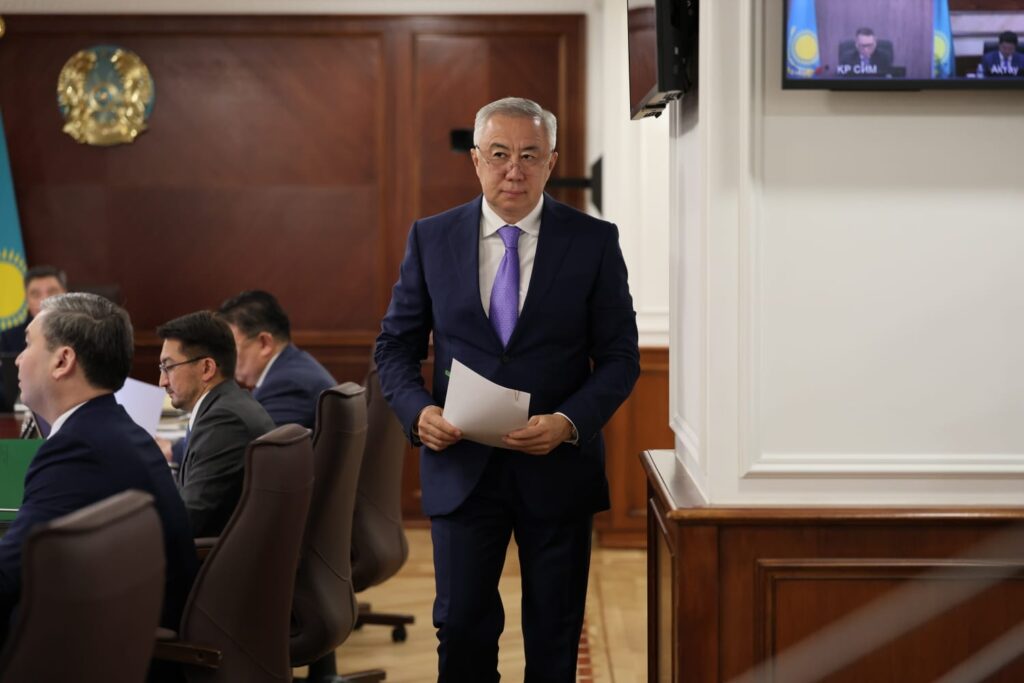
«I consider it prudent to raise loans, especially from international financial institutions. The country’s development proceeds much faster. As of July 1, 2026, the national debt stands at 38.5 trillion tenge. This represents just 20.9% of GDP. We operate within the limits established by the Public Finance Management Concept — a ceiling of 32% of GDP. We are classified as a low-debt country. We closely monitor how much we borrow, the methods we use to borrow and who our lenders are. The majority of the debt — around 75% — is domestic debt. We also maintain substantial capital buffers, such as the National Fund.»
«Citizens can rest easy in this regard,» the minister said.
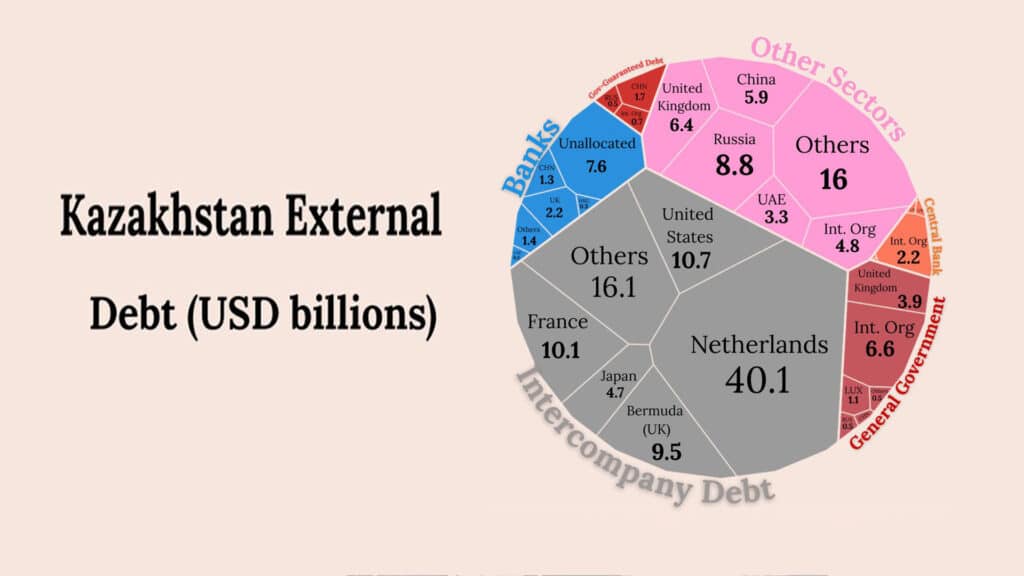
Read also: Kazakhstan’s external debt in 2025 and budget for 2026 visualized.
Zhumangarin added that all decisions on foreign borrowing are based on how the loans will be repaid. Previously, loans from the Asian bank were issued directly to the government. Under the new approach, the government will provide state guarantees for loans tied to specific projects. Crucially, the projects themselves must generate enough revenue to service the debt.
For example, in the case of railway construction, transport tariffs must cover both principal and interest payments. If a highway is built, the debt would be repaid through tolls charged to freight and passenger vehicles.
The minister said the national debt would not increase as a result of the new borrowing because economic growth would offset the additional debt.

«We project a figure of around $360 billion to $370 billion by the end of this year. It is a matter of proportion, with GDP as the denominator, so the debt-to-GDP ratio will depend on our growth rate. We have no desire to borrow in an ill-conceived, imprudent, inefficient or, most importantly, nontransparent manner,» Zhumangarin said.
AIIB financing on favorable terms
Earlier, while presenting the agreement with the AIIB at a Kurultai session, the minister said its ratification would allow Kazakhstan to expand access to favorable financing. He highlighted the bank’s flexible terms, including repayment periods of up to 35 years and interest rates ranging from 1% to 1.5%, depending on the loan currency — U.S. dollars, yen, yuan or euros.
«In the five years following ratification, the framework agreement will allow us to attract approximately $6 billion in additional ‘long-term capital’ on concessional terms into the country’s economy, targeting sectors such as transport, energy, health care and green finance,» Zhumangarin said.
Notably, Kazakhstan allocates 11.1% of total government expenditure to net interest payments on public debt, equivalent to 3.8% of the country’s GDP.