From trading to ecosystems: How Freedom Investments is rethinking brokerage


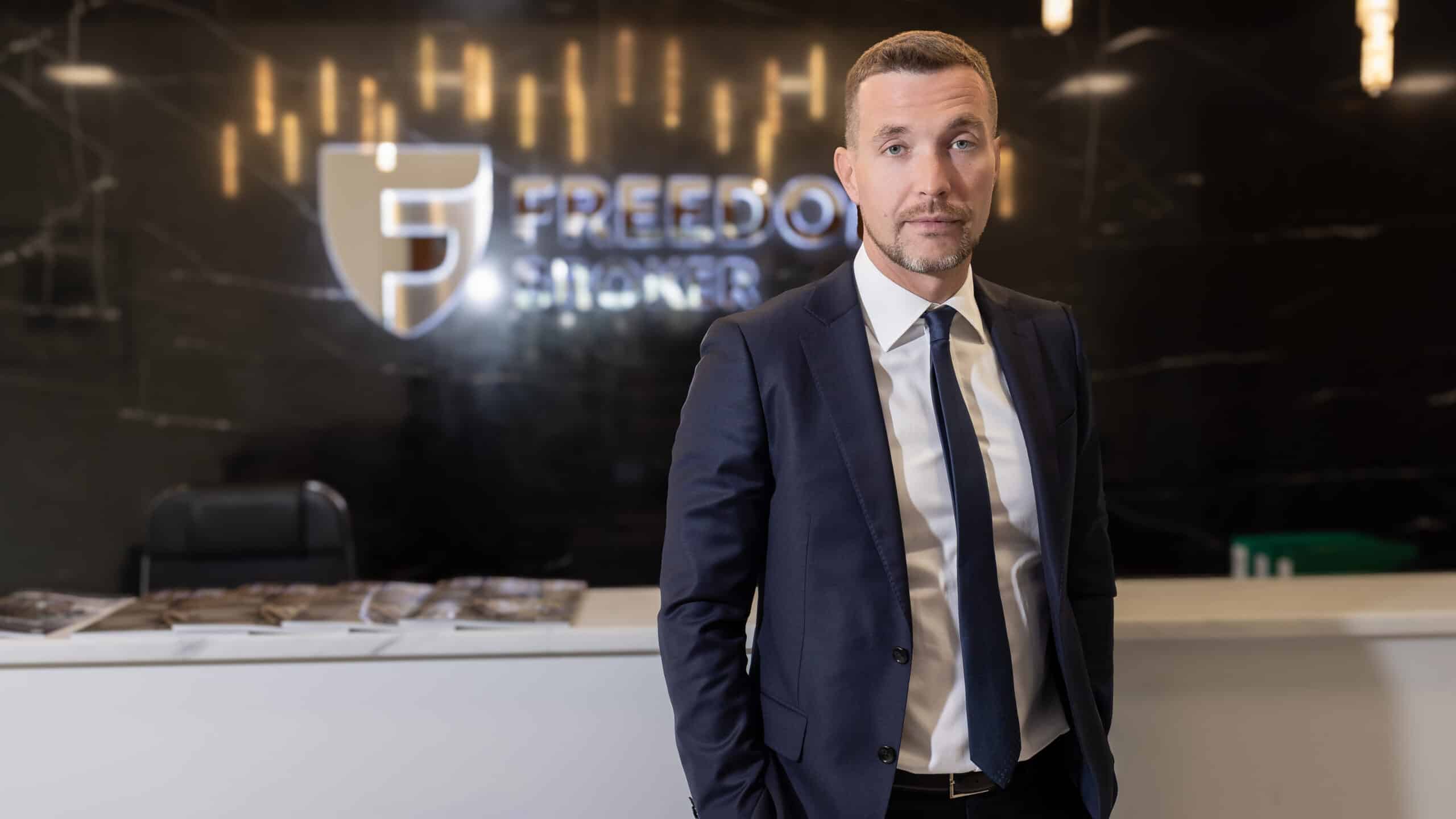
The retail investor has changed over the past 20 years. Today, simple access to stock trading is no longer enough; investors need analytics, ecosystem services and smart AI assistants. In an interview with Kursiv.media, Aleksei Maksimkin, managing director for client business development strategy at Freedom Investments, spoke about how the company segments its nearly 400,000 clients, why it pays for their taxi rides, why it discourages newcomers from trading aggressively and how IRONMAN triathlon training helps with capital management.
— You have been working in the stock market for about 20 years. How has the brokerage client changed during that time? What does a client expect from a broker today beyond just market access?
— In the past, a broker provided only access to the exchange — the trading platform itself — thereby satisfying the need to buy and sell assets and nothing more. Now, beyond trading, clients need ancillary products and services: education, investment ideas, market analytics, access to consultations with specialists and other features. These have shifted from being «extra» demands to a standard baseline offering. As financial markets evolved and new products emerged, clients realized that a broker could help them achieve one or several financial goals at once. For instance, they may want to maximize capital growth, preserve or accumulate wealth conservatively or hedge against inflation.
— Freedom Investments has over 380,000 open accounts in Kazakhstan. How do you segment such a large client base?
— There are 387,000 accounts: 40,000 opened with Freedom Finance JSC and 347,000 with Freedom Finance Global PLC. Of course, behind these figures are real people with their own goals, backgrounds and expectations. To provide the best possible investment experience, we need to approach segmentation with nuance.
We analyze clients based on three parameters. The first is «account balances.» This helps determine the service level, or client segment, and the privileges available. The second is «transactional behavior,» which is how a person uses their brokerage account. This includes trading frequency, the instruments traded, capital turnover rates and so on. Based on this, we categorize clients into four groups: investors, traders, speculators and dormant clients. The third parameter is the «risk profile,» or the level of risk the client is willing to accept in their investment portfolio while pursuing their financial goals. We employ a scoring model with three risk levels: conservative, moderate and aggressive.
By considering these parameters in combination rather than in isolation, we better understand which personalized products, services, communication channels and information each client needs at any given time.
— Clients see five tiers in the loyalty program. To what extent does this classification reflect actual internal segmentation? Do two clients with $100,000 portfolios fall into the same segment?
— The loyalty program is a system that is simple and clear for the client. A specific asset volume corresponds to a specific set of benefits. The program has five tiers: Standard (portfolio up to $5,000), Silver ($5,000 to $20,000), Gold ($20,000 to $50,000), Platinum ($50,000 to $300,000) and Priority (over $300,000).
That covers the «external» aspect. Internal segmentation, in turn, helps us better understand each individual’s needs. For example, two clients with $100,000 portfolios fall into the same loyalty tier — Platinum. However, one focuses on long-term investments while the other trades actively. Although their privilege levels are identical, the content of our communications and the investment ideas we present should differ.
Thus, the loyalty program and segmentation complement each other. The former defines available benefits and a path to higher tiers, while the latter helps tailor interactions between the broker and each client. This applies to the entire service experience: the investment ideas a client receives, the educational resources offered and when assistance from a manager is required. At the same time, needs can evolve: a client gains experience, increases their capital and sets new financial goals. We must recognize these changes, factor them into our work and help the client grow and advance to the next tier of the program. This is how we build long-term relationships in which the client understands the value of working with the broker at every stage — from initial investments to managing substantial capital.
— What parameters determine a client’s value to Freedom Investments?
— Our primary metric is lifetime value (LTV), which is the value of the relationship over the entire course of the client’s journey with us. We assess client value not just at a given moment in time but over a horizon of five to 10 years and beyond.
Over that period, an individual’s personal income, capital, financial goals and risk appetite may all change. Initially, a client might start with a small sum, then build up savings and later manage the finances for their entire family. Segmentation helps us track these changes and understand how we can add value at each stage.
If we evaluate a client solely based on their current balance or transaction volume, we miss the bigger picture. We should build long-term partnerships that offer value to both parties.
— In one of your posts, you mentioned «managing inertia» for data monetization. What exactly is an «inert client,» and how do you activate them?
— Client inertia can occur at various stages. Broadly, we see it at points such as account opening, funding, or the period leading up to the first trade. This is why we map out a unique journey for each client, with specific trigger events identified in the customer journey map (CJM).
A shift in behavioral segment can also trigger an action. For instance, if a client funds their account and begins trading, the system might offer free training at our academy or a guided trading session with a mentor. If a client shifts from active trading to long-term investing, we might suggest ideas involving bonds, funds or other passive investment vehicles. If their interest shifts toward speculative trading, we offer different products — such as options — provided this aligns with their risk profile. In other words, a change in behavior signals a need to adjust our engagement strategy and offer products that are more relevant to the client.
— Where do you draw the line between helpful personalization and trying to push a client into making more trades to generate commissions?
— The number of trades is not a goal in itself. For instance, infrequent trading activity can be perfectly normal behavior for a client with a long-term strategy.
It is not in the broker’s interest for a newcomer to start trading aggressively, lose money and leave convinced that the stock market is a scam. We want the client to understand what they are doing, align their actions with their goals and stay with us for the long haul. In some situations, we even discourage excessive trading, as our priority is LTV.
However, discipline on both sides is crucial here: The client must answer risk-profiling questions honestly rather than overstating their risk tolerance. Otherwise, the client ends up deceiving not only us but also themselves, which inevitably leads to a negative investment experience.
— How did the idea for the investment product featuring a mentor come about?
— There were two considerations. The first was economies of scale. How do you give a large audience access to professional expertise? In a one-on-one format, any expert’s capacity is limited by their time. Live online broadcasts let us analyze the market for many clients at once, explain the rationale behind decisions and answer questions in the chat. This makes expertise accessible to a much wider range of investors.
The second factor was unit economics — specifically, the ratio between the cost of servicing a client and the revenue generated from them. About 80% of our clients have less than $5,000 in their accounts. Assigning a personal manager to each of them is economically unfeasible. A group format allows us to offer this audience expert support while keeping service costs reasonable.
That is why we launched live broadcasts where specialists with 15 years of experience analyze the market in real time. These aren’t personalized investment recommendations but an opportunity for hands-on learning: understanding instruments, asking questions and analyzing common mistakes. For novice investors, this kind of regular engagement helps build discipline and leads to more informed decision-making.
— Have there been instances where widespread feedback prompted you to change the product?
— All ideas are first tested on a small sample group. After launch, we measure the Customer Satisfaction Index (CSI). For instance, a test group indicated that checking their account balance was more convenient via a familiar messaging app rather than the trading app itself. In response, we created a WhatsApp chatbot that quickly provides the necessary information after authentication. That addressed the need.
— What do you consider the primary indicator of quality in the client-facing business?
— There is no single ideal indicator; metrics vary by stage. At the outset, I look at the funnel: the number of accounts opened, conversion rates and the time it takes to execute the first trade. Over the client’s lifecycle, metrics like LTV, churn rate, segment migration and CSI/NPS (Net Promoter Score) trends become important. The number of active clients matters for the mass retail segment, but it’s not a key indicator for the Priority segment. Clients have different objectives and we don’t expect frequent trading from them. In short, there are many indicators and data points and no single key performance indicator (KPI) covers every area of interest and oversight.
— To what extent does the broker personalize the interface?
— The Freedom Broker app itself is a trading platform with a unified core architecture, though clients can customize their dashboards. Investment ideas, however, are fully personalized. We deliver them via push notifications, WhatsApp or email, tailoring them to the specific investor’s language, segment and risk profile.
— What role remains for the human manager after the implementation of an AI agent?
— An AI agent handles routine requests with a single click, such as changing a tariff plan, locating an office, checking charged fees, retrieving contact numbers and so on. This has diverted tens of thousands of inquiries away from the support team. Human managers remain available for the VIP and Priority segments, where deep expertise is required. However, we are seeing a trend: Younger clients with capital starting at $50,000 are increasingly opting for self-service. The bot operates around the clock from anywhere in the world with an internet connection. Unlike third-party neural networks, it has secure access to client account data.
— Why are you introducing non-financial perks such as taxi services and airport lounges and how do they impact retention?
— We recently raised the Yandex.Taxi allowance for the Priority segment from 10,000 ($22.71) to 20,000 ($45.41) tenge and service usage doubled. The key insight here is that the average CSI for clients who use the taxi service reaches 4.84, whereas the average for the high-net-worth segment overall is 4.6 to 4.75. Non-financial services boost loyalty, help retain clients and become an integral part of their daily lives.

— How do you ensure this loyalty is sustainable so that clients don’t defect to competitors simply for better cashback offers?
— Typically, a person uses two or three financial institutions: one for low-cost transactions, another for investments and savings and a third for comprehensive family banking. Our goal is to meet all these needs within a single ecosystem. If a client only has a brokerage account with us, they might easily leave at the slightest hiccup. But if they use our cards, insurance and lifestyle services, their loyalty to the brand increases significantly.
— Kazakhstan is lowering its base rate. Will this shift funds from bank deposits to the stock market?
— Tenge-denominated deposits still offer attractive yields exceeding 16%. However, by law, banks cannot pay more than 1% on foreign currency deposits. Consequently, clients holding dollars are turning to brokers; we offer rates of up to 6% per annum in U.S. dollars on D-accounts for 12-month placements. Recently, some Kazakhstani issuers have also raised funds by listing bonds on the Kazakhstan Stock Exchange (KASE) and Astana International Exchange (AIX). Unfortunately, there is currently a scarcity of tenge-denominated corporate securities from reliable issuers; companies are not bringing debt to market because raising expensive capital for projects is not cost-effective. As a result, retail investors are beginning to convert the national currency into foreign currency for future investments to hedge against inflation and diversify their holdings by currency.
— You recently launched a student-specific plan. Is this an investment in future clients?
— Ninety-six people have signed up for the plan, with most holding less than $1,000 in their accounts. For us, this is an educational initiative, not a commercial one. Many students currently confuse investing with crypto trading — trying to guess the price of Bitcoin. We teach them a fundamental discipline of setting aside at least 10% to 20% of any income and investing it in basic financial instruments like stocks and bonds. By leveraging compound interest over a 20- to 30-year horizon, even 1,000 tenge can grow into substantial retirement capital. You can select specific financial instruments later; the priority is to build the habit first.
— What are brokers competing over right now?
— Slashing commissions is a dead-end strategy. The real competition is becoming the client’s number-one partner — the one who meets all their financial needs. The winner provides a comprehensive ecosystem where clients are willing to entrust their capital and bring in friends and business partners, where their entire family is served and where partnerships are built to last for decades.
— You are a triathlete and have completed an IRONMAN. How do you reconcile athletic discipline with a broker’s need for clients to engage in active trading?
— There is a rule that applies to both sports and investing: To achieve a desired outcome in the future, you must persist today in doing things that you might not want to do. There is no magic pill for an IRONMAN; there is only routine, planned training. Finance works the same way. You have to show restraint today — investing 20% of your income instead of buying a new iPhone — so that 20 years from now, you have the capital to ensure a high quality of life.