


The Almaty Air Initiative foundation conducted an experiment in Almaty to demonstrate how air pollution can enter the human body.
Five volunteers participated in the experiment. They arrived at a laboratory in the morning, where researchers took initial blood samples. The participants then walked along busy streets within the area bounded by Satpayev, Zharokov, Abai and Rozybakiyev streets.
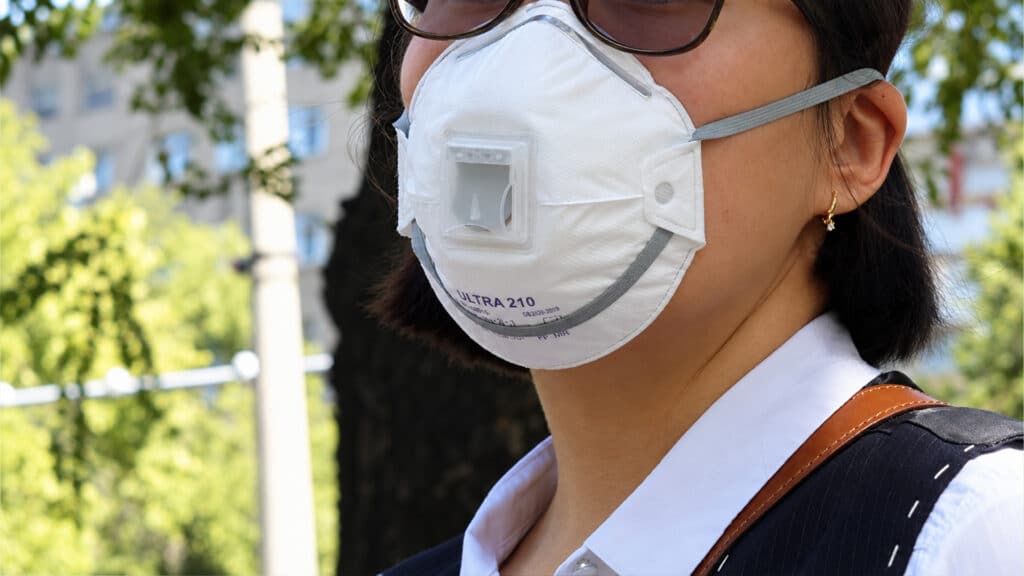
Two volunteers wore KN95 respirators during the walk, while the others went without masks. A sensor recorded PM2.5 concentrations of 10-15 micrograms per cubic meter during the walk.
Upon their return, researchers took additional blood samples and examined them under a light microscope. No distinct foreign elements were found in the samples collected before the walk. Afterward, however, dark inclusions appeared on individual red blood cells in samples from participants who had not worn respirators.
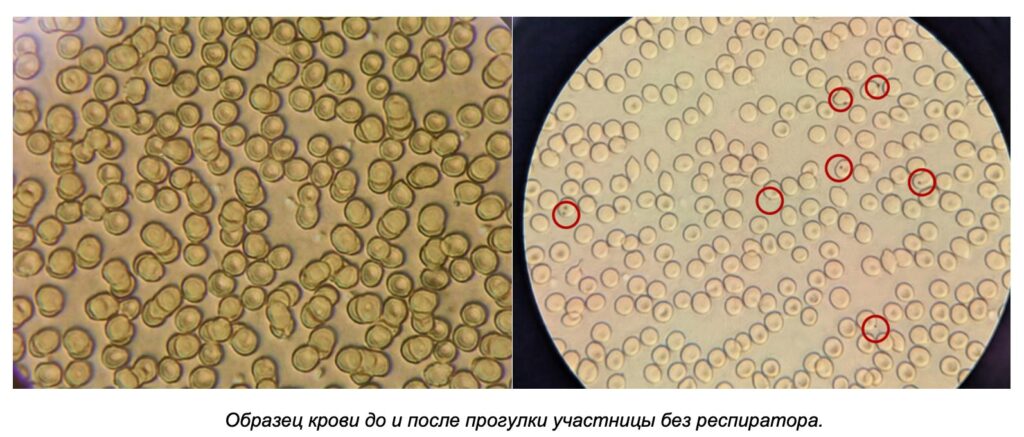
According to Zhuldyz Saulebekova, head of the Almaty Air Initiative, air pollution does not remain solely on the outside of the body; tiny particles can enter the bloodstream and be carried throughout the body.
Findings linked to previous research
«Research by Queen Mary University of London and the Almaty Air Initiative experiment confirm that, after spending time near a busy road, there is a high probability that carbon- and metal-containing particles — characteristic of vehicle exhaust, brake wear and tire wear — will appear in a person’s blood,» the Almaty Air Initiative said.
Read also: Kazakh teen develops innovative ink from city’s air pollution.