
Kyrgyzstan leads Central Asia in economic growth, ADB reports



The Asian Development Bank (ADB) has assessed how Central Asian economies will grow in 2026. According to the bank’s September outlook, Kyrgyzstan is expected to record the region’s fastest GDP growth at 8.9%. The economies of Tajikistan and Uzbekistan are expected to grow by 7.0%, while Turkmenistan’s GDP is forecast to increase by 6.3%. Kazakhstan ranks last, with projected growth of 4.8%.
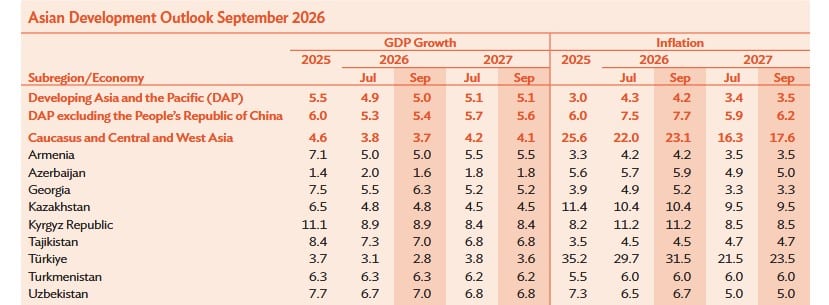
Kyrgyzstan leads the region in economic growth. Its economy is supported by public investment, consumption and construction, including state-backed housing programs. At the same time, the current account deficit widened to 24.4% of GDP in the first half of 2026 as exports and migrant remittances declined. Furthermore, the bank notes that trade and domestic demand are weakening, while industry faces electricity shortages.
Tajikistan’s economy grew by 8.2% in the first half of 2026, supported by manufacturing, food processing, metallurgy and trade. However, the ADB lowered its 2026 growth forecast for the country from 7.3% to 7.0% due to disruptions in fuel supplies.
Uzbekistan, on the other hand, had its growth forecast raised from 6.7% to 7.0%. In the first half of 2026, the country’s GDP grew by 8.5%, supported by services, industry, construction and strong investment in energy, manufacturing, transport and housing. The ADB noted that growth is expected to slow in the second half as external demand weakens and energy prices remain high.
According to official data, Turkmenistan’s economy grew by 6.3% in the first half of 2026. The ADB attributes this growth to public investment in infrastructure, as well as activity in construction, trade and transport.
In the first half of 2026, Kazakhstan’s economy grew by 4.1%, down from 6.3% a year earlier. The slowdown was driven by an 8.4% decline in oil production, following an extended shutdown at the Tengiz field in the first quarter and repeated disruptions at the Caspian Pipeline Consortium (CPC), which transports more than 80% of the country’s oil exports.
Other sectors of the economy remained resilient. Manufacturing growth accelerated to 9.8%, up from 5.6%, amid government support. Construction grew by 15.2%, while services expanded by 3.6%. The bank noted that non-hydrocarbon exporters in Central Asia and most Caucasus countries continued to expand robustly, while growth slowed in the region’s two largest hydrocarbon exporters, Kazakhstan and Azerbaijan.
Inflation remains elevated across the region. The ADB projects inflation at 11.2% in Kyrgyzstan in 2026, up from 8.2% in 2025, followed by 10.4% in Kazakhstan, 6.7% in Uzbekistan, 6% in Turkmenistan and 4.5% in Tajikistan.
What to expect in the region in 2027
Growth is forecast to slow across most countries in the region. The ADB projects growth of 8.4% in Kyrgyzstan, 6.8% in both Tajikistan and Uzbekistan, 6.2% in Turkmenistan and 4.5% in Kazakhstan. The main risks are related to energy markets, ongoing conflicts and a severe El Niño event that could affect crop yields and hydropower generation.
