

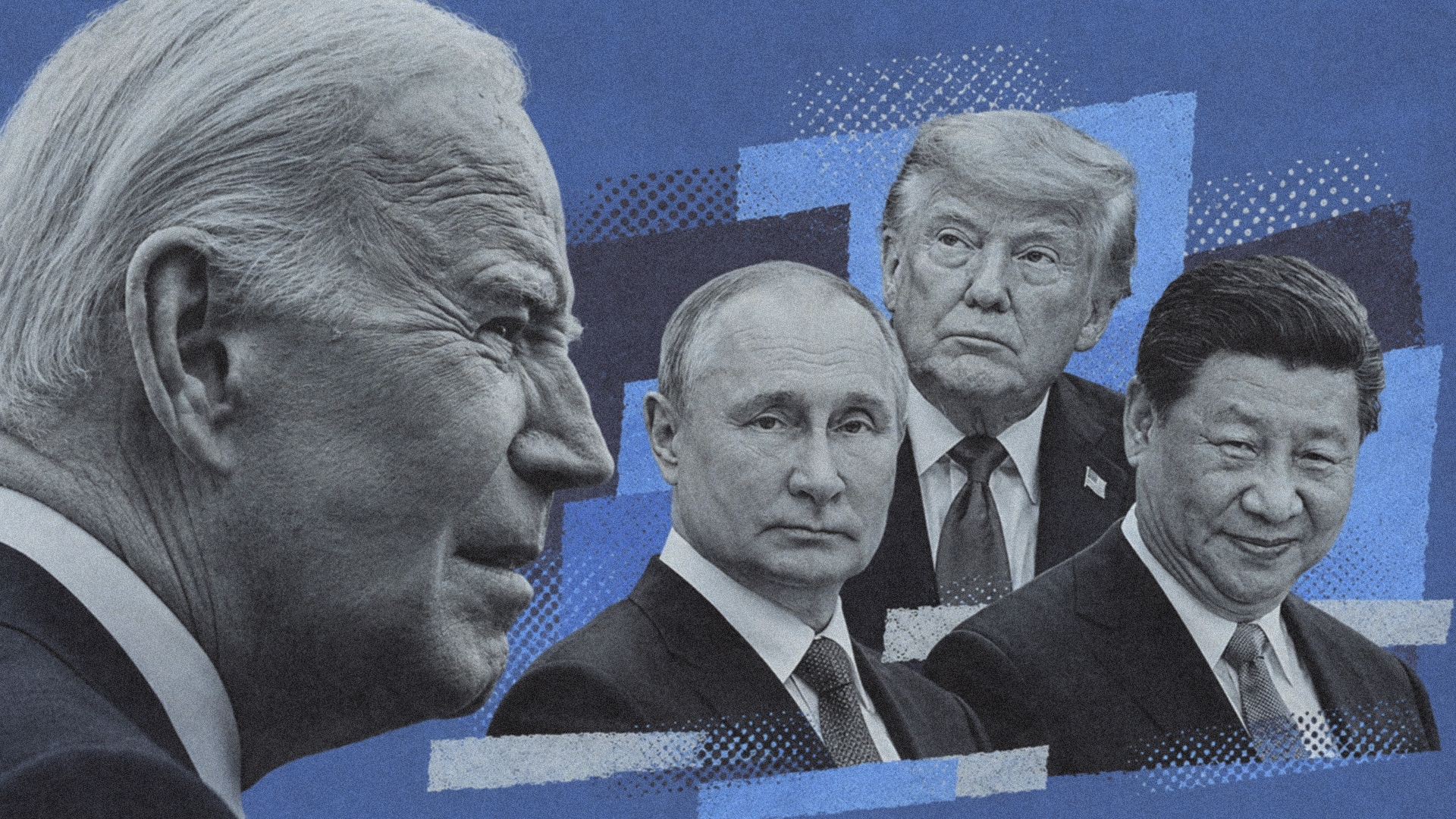
The leaders of China, the U.S. and Russia are gathering in Shenzhen for their first-ever formal trilateral summit, a historic meeting that has prompted comparisons with the 1945 Yalta Conference. The gathering comes just two days after former U.S. President Joe Biden published his memoir, «Promise Me, America.»
Drawing on personal anecdotes, historical context and his experiences in the Oval Office, Biden offers candid assessments of major international figures and American political leaders. His accounts provide a glimpse into how he viewed some of the world’s most influential figures during his presidency.
Let’s look at how he portrays Donald Trump, Vladimir Putin, Xi Jinping and Ukrainian President Volodymyr Zelenskyy.
Donald Trump: Political division and disregard for democratic norms
Biden portrays Donald Trump as a deeply divisive political figure whose presidency was marked by confrontational rhetoric, unpredictable behavior and repeated challenges to democratic institutions.
Biden is particularly critical of Trump’s refusal to accept the results of the 2020 presidential election and his role in the Jan. 6, 2021, attack on the U.S. Capitol. He describes Trump’s conduct during the crisis as one of the most serious failures of presidential responsibility in American history.

On the international stage, Biden also takes issue with Trump’s approach to traditional U.S. allies and his apparent affinity for authoritarian leaders, including Putin. He recalls how former German Chancellor Angela Merkel expressed frustration with Trump’s behavior and questioned his fascination with politicians who displayed authoritarian tendencies.
Biden also criticizes Trump’s handling of the COVID-19 pandemic, arguing that his administration failed to provide the steady leadership and respect for scientific expertise that the crisis demanded.
Interestingly, however, the memoir also reveals a more personal side of Trump. Biden recalls being surprised by the warmth of a farewell letter Trump left for him at the White House in January 2021, as well as a cordial conversation between the two after the 2024 presidential election.
Vladimir Putin: Resentment and calculated displays of power
Biden depicts Russian President Vladimir Putin as a deeply resentful leader whose political outlook is shaped by historical grievances and a desire to restore Russia’s influence.

Recalling their face-to-face meetings, Biden pays particular attention to Putin’s personal mannerisms. He writes that the Russian leader liked to «slouch during a meeting, feigning indifference, like a teenager.» Biden also describes Putin’s tendency to arrive late to meetings, interpreting such behavior as a way of projecting power.
On the political front, Biden criticizes Putin’s consolidation of power, repression of political opponents and disregard for democratic institutions. He also links the Russian leader’s historical worldview to his decision to launch a full-scale invasion of Ukraine in February 2022.
Xi Jinping: Strategic competition and pragmatic diplomacy
Biden approaches Chinese President Xi Jinping from a somewhat different perspective, portraying him as a powerful leader presiding over China’s growing international influence and increasingly centralized political system.

The memoir reflects Biden’s concerns about China’s economic and geopolitical ambitions, including its expanding international infrastructure and trade initiatives under the Belt and Road Initiative.
At the same time, Biden describes his dealings with Xi as pragmatic, emphasizing the importance of maintaining diplomatic channels despite fundamental disagreements over human rights, Taiwan and trade.
Read also: Conspiracy claim: Trump says US foes are teaming up.
He also expresses concern about China’s increasingly close relationship with Russia. In particular, Biden points to the strategic partnership between Xi and Putin, formalized in their declaration of a «no limits» friendship shortly before Russia’s full-scale invasion of Ukraine in 2022.
Volodymyr Zelenskyy: From television actor to wartime leader
Biden’s account of Ukrainian President Volodymyr Zelenskyy offers an interesting perspective on the transformation of an unconventional political figure into a wartime leader.

Before entering politics, Zelenskyy became widely known for playing a fictional Ukrainian president in the television comedy series «Servant of the People.» His background as an actor initially raised questions about his readiness for high-level political office.
However, Biden acknowledges that Zelenskyy’s experience in front of an audience proved valuable in his new role. He writes that the Ukrainian leader’s acting background «turned out to be very good training» for the demands of wartime leadership.
Read also: ‘I despise Zelenskyy’: Ex-Russian lawyer turned Ukrainian citizen speaks out.
Biden also recognizes Zelenskyy’s ability to communicate effectively with the public, mobilize international support and rally Ukrainians around their country’s defense following Russia’s full-scale invasion.
His personal assessment, however, is not entirely flattering. Biden acknowledges that Zelenskyy could be moody and stubborn during private conversations and was sometimes less appreciative of American support than the former U.S. president had expected.
