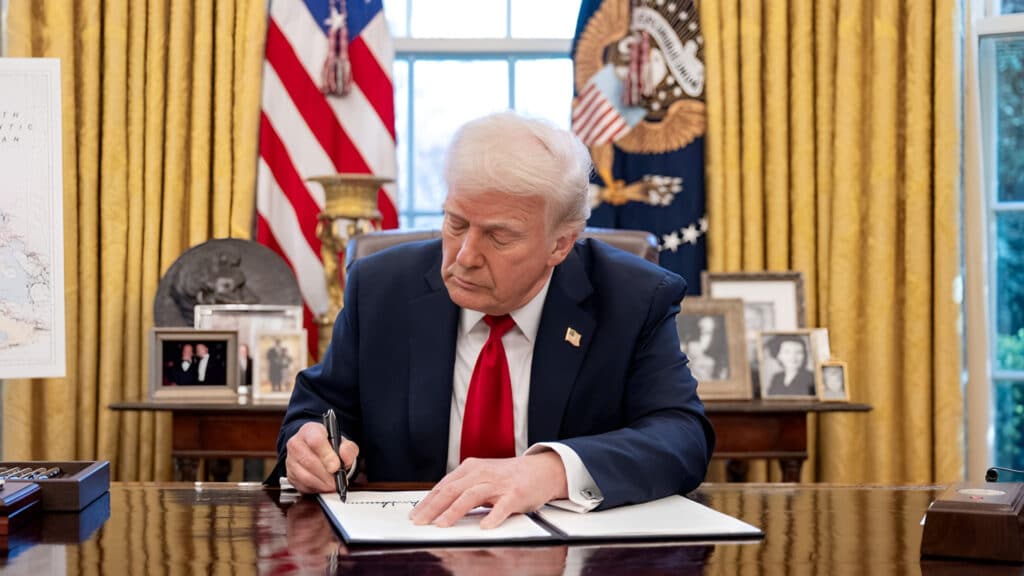
On Dec. 11, U.S. President Donald Trump signed an executive order that prevents U.S. states from introducing their own artificial intelligence (AI) regulations. Trump argued that the fast-evolving AI industry needs unified federal oversight rather than a patchwork of state rules, warning that conflicting state-level regulations would hurt the nation’s ability to compete globally, especially with China, the Associated Press reported.
Trump said there is «only one winner» in the global AI race, noting that the technology is widely seen as critical for the future and that China has already streamlined its regulatory approach to the sector.
«We have the big investment coming, but if they had to get 50 different approvals from 50 different states, you can forget it because it’s impossible to do,» Trump said.
Under the executive order, federal authorities are instructed to identify state regulations viewed as problematic and challenge existing state laws. The administration has also indicated that it may consider limiting access to funding from broadband deployment and other grant programs for states that impose what it describes as «onerous» AI regulations.
Meanwhile, calls for stronger AI regulation continue among some members of Congress and consumer advocacy groups, who argue that oversight has not kept pace with the technology’s rapid development. Several states, including Colorado, California, Utah and Texas, have already passed laws restricting the collection of certain personal data and requiring greater transparency from AI companies.
In addition, many states have enacted targeted AI rules, such as banning the use of deepfakes in elections and the creation of nonconsensual explicit content, as well as setting limits on how government agencies may use AI technologies.