Renat Tukanov: “The key role of IT is to help business grow”

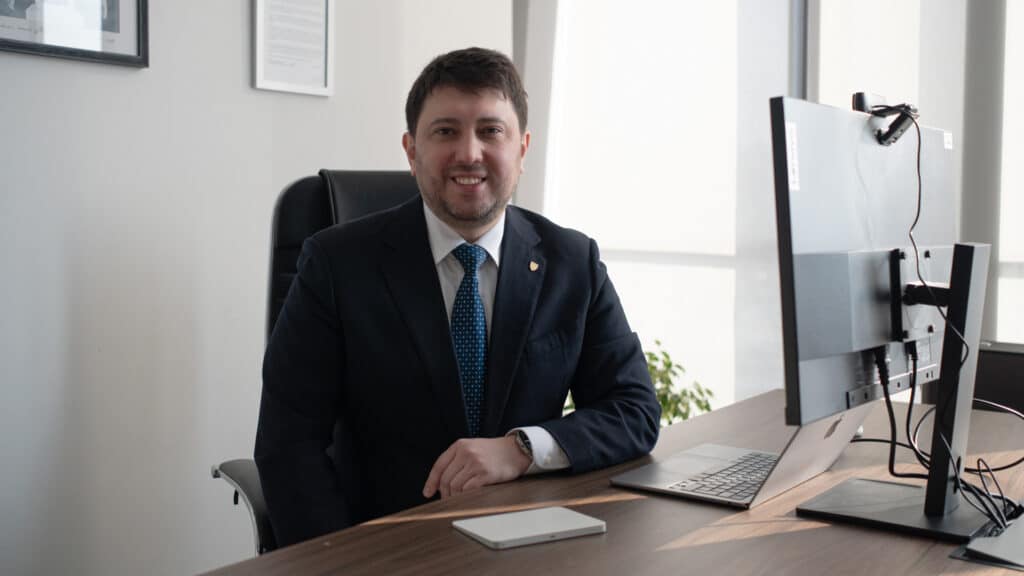
Freedom Holding Corp. has grown from a small brokerage into a $10 billion ecosystem spanning more than 20 business lines — from banking and insurance to telecommunications and ticketing. How does the company manage technology across more than 30 different subsidiaries? Why does it need a Group CTO, and how does that role differ from a traditional CTO?
In an interview with Kursiv.media, Freedom Holding Corp.’s Chief Technology Officer (CTO) Renat Tukanov shared his perspective on building effective collaboration between IT and the business, saving $8 million in a single year, why negotiation skills matter more than coding, even for top engineers, and what the holding company could look like five years from now.
— Renat, first of all, what is a Group CTO? What strategic objectives and areas are you responsible for?
— Freedom Holding Corp. gradually evolved into a holding company. Ten years ago, the group consisted of only a few companies and a handful of IT specialists. Naturally, the scale and complexity of management were very different back then. However, as the company expanded into new areas and diversified across industries, it became clear that the previous technology management model was no longer viable.
Traditionally, any company has business functions that directly generate revenue, as well as supporting departments such as finance, accounting, compliance, risk and IT. In many cases, technology has been viewed as a support function. As a result, IT was not seen as a source of competitive advantage but as a cost center.
This logic does not apply to Freedom, because its core business is built on digital products and platforms. The sustainability, scalability and reliability of these technologies are absolutely critical, as they directly determine the company’s ability to generate revenue — not only in the short term, but for many years to come. At the same time, the technology landscape is constantly evolving: IT architecture is becoming more complex, regulatory requirements are more stringent and the importance of cybersecurity and data continues to grow.
Therefore, the role of a Group CTO goes far beyond «IT management.» It is about ensuring long-term, sustainable and predictable business growth through technology. Our goal is to create a technological foundation that allows our businesses to pursue their product ambitions with confidence, knowing that the infrastructure, architecture and processes will consistently support them.
— How does the role of a Group CTO differ from that of a CTO at an individual company?
— A CTO at an individual company typically focuses on the product, operational processes and delivering specific business results within that organization. The key responsibility of a Group CTO, by contrast, is to ensure the consistent and predictable development of technology across the entire holding company, so that it supports the growth of each business while also functioning as a unified system.
In practice, this means continuously building alignment among companies, teams and functions, and creating a shared management and technology context in which complex decisions can be made thoughtfully, without unnecessary conflict or resistance.
Another critical part of the Group CTO’s role is shaping and promoting a shared vision for the technological development of FRHC and all its subsidiaries. This is not about «selling ideas,» as it might seem, but about establishing a common logic and framework for discussion — one in which proposed solutions feel logical, well-reasoned and broadly supported by all stakeholders.
A further critical area of our work is the systematic centralization of technology services and their delivery to group companies through a service model. That said, we don’t push centralization when it isn’t necessary. We recognize that not all services can or should be consolidated into a single system, especially if doing so reduces business agility or slows down decision-making.
All our centralization decisions are based on clear criteria. First of all, a service must be standardized — with a well-defined architecture, formalized processes and transparent operating rules. It must be scalable and in demand across dozens of companies to ensure an efficient unified approach. Finally, the service must be critical for compliance and security — two areas where centralized IT controls are essential, including access management, logging, change management and regulatory compliance.
— This is quite a complex structure; how do you ensure technological maturity?
— We view technology through the lens of a product pipeline. Businesses have products that go through a specific life cycle — from conception and design to operation and scaling. Our goal is to integrate technology into this pipeline so that each subsequent stage further matures the product.
In Kazakhstan, we created a unified infrastructure based on Freedom Cloud. Today, all companies in the holding use a centralized infrastructure. This was done not for the sake of formal unification, but to shift the focus — so that Chief Information Officers (CIOs) across the group can concentrate on product development rather than infrastructure operations.
— How can one measure IT’s contribution to business growth with this approach?
— There are some economic indicators we can use to measure such a contribution. For example, last year we saved about $8 million by centralizing infrastructure functions and optimizing payroll. The unified system is currently maintained by approximately 50 specialists. A decentralized model would require about 250 people with comparable qualifications, and this is only an estimate — we would hardly have been able to find that many employees within a short period.
Furthermore, bulk equipment procurement offers significantly better terms from suppliers. If each company were to purchase equipment separately, it would always cost more.
There are also some less obvious, but still significant, factors. For example, we have a Red Team — a group of ethical hackers who constantly test our infrastructure and systems for potential vulnerabilities. The team regularly delivers strong results in specialized CTF competitions, making their expertise comparable to that of external organizations. Moreover, maintaining such a team in-house is more effective than outsourcing this expertise.

— What are the key challenges you face when integrating services into an ecosystem?
— The first and foremost challenge is scale. Any initiative within the holding immediately involves numerous stakeholders: business leaders, product teams, CIOs and regulators. Each has its own priorities and worldview.
From a technical perspective, most problems are solvable. The main difficulties lie in human interaction and managing diverse interests.
Any large project ultimately comes down to communication, trust and participants’ ability to reach an agreement. This is not a question of formal approvals or management structure, but rather an element of maturity — the ability to listen to one another, acknowledge limitations and find solutions that work for the system as a whole, not just for a single function or team.
That’s why we must develop not only engineering expertise but also management skills. This means the ability to work with uncertainty, build dialogue between business and technology, explain complex issues in simple terms, and take responsibility for decisions that inevitably affect multiple companies and dozens of teams. In an ecosystem setting, these skills are key to the successful implementation of any technology initiative.
— What role do culture and trust play in building an ecosystem?
— The ecosystem approach is based on a simple principle: together, we can move much faster than we can separately. This is where the ecosystem effect comes into play. Today, for example, SuperApp has approximately 4 million users. This means that by joining the ecosystem, a business immediately gains access to a large customer base. This is a significant competitive advantage that accelerates the growth of new products and services.
However, an ecosystem is not only about technology and reach, but also about a culture of collaboration and trust among participants. Without this, no integration works. Even the most powerful technological solutions lose their effectiveness if companies within the ecosystem continue to operate in isolation, protecting only their own interests.
An ecosystem becomes truly effective when companies within it begin to see one another as parts of a single structure. This requires time, maturity and deliberate management. At that point, synergy stops being an abstract concept and becomes tangible metrics — such as speed to market, cost reduction and the ability to scale faster than the market.
— What is the division of responsibility between the holding company and its subsidiaries?
— Operational and product responsibility remains with the individual companies. Since CIOs and technology teams understand their business specifics, product logic and operational processes best, they can make the most effective decisions at the level of specific services and clients.
The holding company’s role is to define strategy, principles and standards, and to step in where centralization delivers the most significant impact.
A good example is information security. This is an area where a distributed model without unified rules quickly leads to inconsistent levels of maturity and increased risk. As a result, we identified 18 key information security processes and deliberately redistributed responsibilities between the subsidiaries and the holding company.
The scale of decisions gradually increases as responsibility grows. This changes you as a person as well.
This approach ensures a consistent level of maturity and predictability, faster implementation of changes and incident response, and more transparent communication with regulators and auditors. At the same time, companies retain flexibility in product decisions, while the holding company gains control and transparency across the entire ecosystem.
— What personal qualities are most important for a Group CTO?
— First and foremost, the most important qualities are systems thinking and the ability to understand the business. This isn’t just about listening to business needs, but also about seeing the big picture: how individual decisions affect products, teams, risks and long-term sustainability. Systems thinking in this role is closely tied to discipline — the ability to consistently build processes, maintain architectural logic and drive decisions to results, rather than reacting to challenges on an ad hoc basis.
The second component is working with people and building trust. Any ecosystem consists of multiple interests and perspectives, and without the ability to establish trusting relationships, any initiative remains on paper.
The third component is responsibility and proactivity in the face of uncertainty. At this level, incomplete information and imperfect decision-making conditions are common. It is vital to act with limited data, take responsibility for choosing a direction and see decisions through to implementation, gradually reducing uncertainty and risk.
And finally, a willingness to take reasonable risks and continue developing. As a Group CTO, it is impossible to rely solely on proven approaches and experience. A certain degree of courage is required — not as the opposite of systems thinking but as a complement to it. It is the combination of curiosity, a willingness to try new things and the ability to relearn that allows you to move forward without getting stuck in established models.
— What was the most challenging management decision you’ve made as CTO? And what conclusions did you draw from it?
— There have been many such decisions, and frankly, they don’t get easier with experience. I would rather say that their nature changes. You do begin to cope with them more easily, but not because the stress subsides or doubts disappear. This happens because you have already dealt with decisions of a different scale and know how to handle them.
The scope of decisions gradually grows along with the level of responsibility, and you change along with it. The decisions we made 10 years ago, when I first joined Freedom, were mainly of the same type — they were complex in context but limited in their consequences. Today, the scale is entirely different: there are more people, more businesses, more risks and a much longer time horizon.
Overall, I have come to realize that the complexity of decisions rarely lies in choosing the «right» option. More often, it is about choosing between several imperfect options, each with its own cost.
The main takeaway for me is that growth in management does not require absolute confidence or a lack of doubt. It requires a willingness to take responsibility for decisions with long-term consequences, to keep moving forward and to conclude without getting stuck in doubt.
— How do you find balance and recover?
Discipline and consistent habits definitely help me. In a high-pressure, constantly uncertain environment, they create a sense of stability and predictability. I’m not talking about a rigid regimen, but rather a consciously established rhythm that helps you maintain focus and make sound long-term decisions.
Education, sports and family time are different forms of recovery, but they all help you refocus. It’s not the quantity of time that matters but its quality. True recovery happens when you are fully present in what you’re doing rather than mentally distracted by other tasks.
Over time, you come to understand that balance isn’t a fixed state or a universal formula. It constantly changes depending on your stage of life and workload. The world is complex and unpredictable, and everyone eventually finds their own set of practices to remain resilient, avoid burnout and stay engaged in both work and life. What matters most is a sense of engagement, meaning and fulfillment.
— What do you think the holding will look like in five years?
— I think that continuing to develop is the most important thing. As the business scales, this inevitably changes not only its structure but also its management principles, technology requirements and levels of responsibility. What works effectively at one stage becomes ineffective at the next, requiring constant reassessment of approaches.
At this point, the question goes beyond the technological landscape alone. It’s about the group’s identity — who we are becoming as an organization, how we make decisions, how well we handle complexity and uncertainty, and whether we are ready to institutionalize management practices rather than rely on individuals or informal agreements. In this context, technology remains a foundation, not an end in itself. Its purpose is to enable rapid business development without creating hidden risks or technical debt. That’s why, over a five-year horizon, what matters to us is not so much individual technological solutions as the ability of the entire system to develop predictably while maintaining flexibility and adaptability.