Kazakhstan’s banking sector will remember the year 2025 for a sharp decline in profit growth amid additional taxation and higher minimum reserve requirements. Growth in loan and deposit portfolios also slowed, though less dramatically than financial results.
Total sector assets rose from 61.6 trillion to 70.8 trillion tenge in 2025 (about $135.7 billion), an increase of 9.2 trillion tenge (Kursiv Research calculations based on National Bank data, unless otherwise noted). In relative terms, assets grew 15.0%, slowing from 19.7% growth in 2024.
Asset growth led by the largest banks
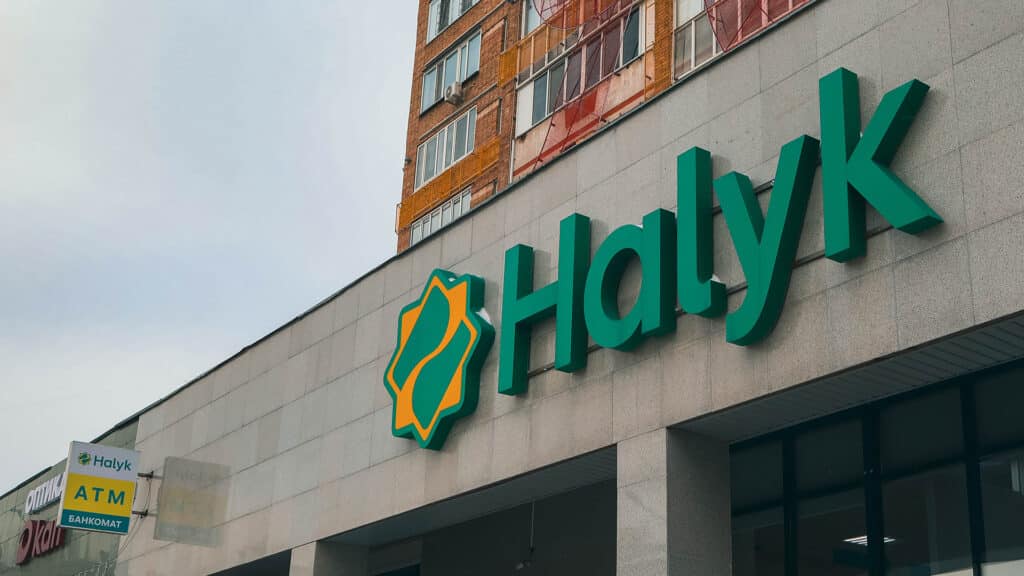
Among individual second-tier banks, Halyk Bank was the year’s leader in asset growth, adding 2.3 trillion tenge. The country’s largest lender further widened the gap with its closest competitors. The difference between Halyk and Kaspi — 9.8 trillion tenge at the start of 2025 — expanded by another 1 trillion tenge to reach 10.8 trillion tenge by year’s end.
Four additional banks posted strong absolute gains. BCC added 1.5 trillion tenge, Kaspi 1.3 trillion, and Forte 1.1 trillion — each exceeding roughly $2 billion in growth.
New entrants have a limited impact
Two new institutions joined Kazakhstan’s banking sector in 2025 as KMF and BNK Bank converted from microfinance organizations into second-tier banks. The total number of banks in the country now stands at 23.
Despite their arrival, the newcomers had virtually no effect on sectorwide statistics. Together, they accounted for just 0.6% of total assets at the start of 2026.
Lagging performers and fastest growers
The weakest performers included Zaman Bank, whose assets fell by 7 billion tenge, and Eurasian Bank, which posted a 116 billion tenge decline.
In percentage terms, Industrial and Commercial Bank of China (ICBC) recorded the fastest growth at 72.2%, though from a relatively small base, leaving it ranked 15th by total assets. Among larger lenders with assets exceeding 1 trillion tenge — 13 banks meet that threshold — Altyn Bank, also Chinese-owned, posted the strongest growth rate at 32.9%.
Lending growth slows but remains solid
The sector’s loan portfolio, excluding repo transactions, increased from 35.5 trillion to 42.7 trillion tenge (about $82 billion), representing 20.1% annual growth, slightly below 21.3% at the end of 2024.
Three shifts occurred within the top 10 banks by loan portfolio size. Bank RBK moved up from ninth to seventh place, pushing Bereke from seventh to eighth and Alatau City from eighth to ninth.
Kaspi showed the strongest absolute lending growth, expanding its portfolio by 1.6 trillion tenge in 2025. Halyk followed with a 1.5 trillion-tenge increase, and Forte added 1.0 trillion. Together, the three banks generated 57.4% of total sector loan growth.
Banks with shrinking loan portfolios
Four lenders recorded portfolio declines during the year. Russia’s VTB, which remains under international sanctions, reduced its loan book by 24 billion tenge. Other declines were reported by Citibank (down 17 billion tenge), Eurasian Bank (down 20 billion tenge), and Alatau City Bank (down 131 billion tenge).
Lending in Kazakhstan has never been a core focus for Citibank. The bank primarily specializes in transactional services for large foreign partners, and loans account for only about 11% of its assets.
Eurasian Bank’s negative trend is most likely tied to a large-scale write-off of problem loans in December 2025.
Alatau City Bank, formerly known as Jusan Bank, changed ownership last summer and is now controlled by Vyacheslav Kim, co-owner of Kaspi. kz. That transition may have contributed to the bank’s reduced appetite for lending.
Bad loans rise faster than the market
The volume of defaulted loans (Stage 3 and POCI) in the sector increased from 2.1 trillion to 2.6 trillion tenge over the year — an increase of 505 billion tenge. In relative terms, growth reached 23.7%, outpacing the overall loan portfolio’s 20.1% growth. In other words, bad loans expanded faster than total lending in 2025.
The share of defaulted loans in the total portfolio rose slightly, from 5.95% to 6.07%. Eleven banks reported ratios below the sector average. Among active universal second-tier lenders, the strongest portfolio quality was recorded by Freedom (1.97%) and Altyn (2.09%). BCC (3.44%), Bank RBK (4.37%), and Forte (5.17%) also showed comparatively solid asset quality.
Profit growth slows sharply
The era of superprofits for banks appears to be ending. In 2025, the sector earned a combined 2.7 trillion tenge (about $5 billion). Year-on-year, profits grew just 6.7%, down from 17.0% growth the previous year.
According to the analytical center of the Association of Financiers of Kazakhstan, the slowdown in net profit growth «reflects rising funding costs, a heavier tax burden, and one-time early repayments of state aid.»
Reshuffling among top earners
The top seven most profitable banks remained unchanged throughout the year. Eurasian Bank dropped sharply — from eighth place to 17th — while Freedom Bank fell from 10th to 19th.
Bereke and VTB filled the two newly opened spots in the top 10. The Russian state-linked VTB rose only one position, from No. 11, while Bereke — until recently also under Russian sanctions — jumped 10 places, from No. 19 to No. 9.
In absolute terms, Bereke ranked second in profit growth, adding 48 billion tenge, behind only Halyk, which increased profit by 132 billion tenge.
Limited group drives profit gains
Aside from Halyk and Bereke, only three banks posted notable profit increases: BCC (up by 45 billion tenge), Kaspi (up by 41 billion), and Forte (up by 22 billion). All other lenders failed to achieve even 10 billion tenge in annual profit growth.