
It’s a trend sparking considerable debate: Democrats appear to use artificial intelligence in the workplace more often than their Republican colleagues. However, education — not ideology — arguably drives the partisan AI gap in the U.S. workforce, according to a recent study by the National Bureau of Economic Research.
Politics, trust and new technology
Political ideology can shape perceptions of and interactions with new technologies. Republicans reportedly express significantly lower trust in scientists and are less likely to embrace certain innovations than their Democratic counterparts. NBER’s new working paper, «The Politics of AI,» explores the intersection of technology and political identity. Authors Nicholas Bloom of Stanford University and Christos Makridis of Gallup and Arizona State University draw on extensive data from the Gallup Workforce Panel (2024-2025) to examine how political affiliation influences artificial intelligence adoption in the U.S. labor market.
Differences in frequency and depth of use
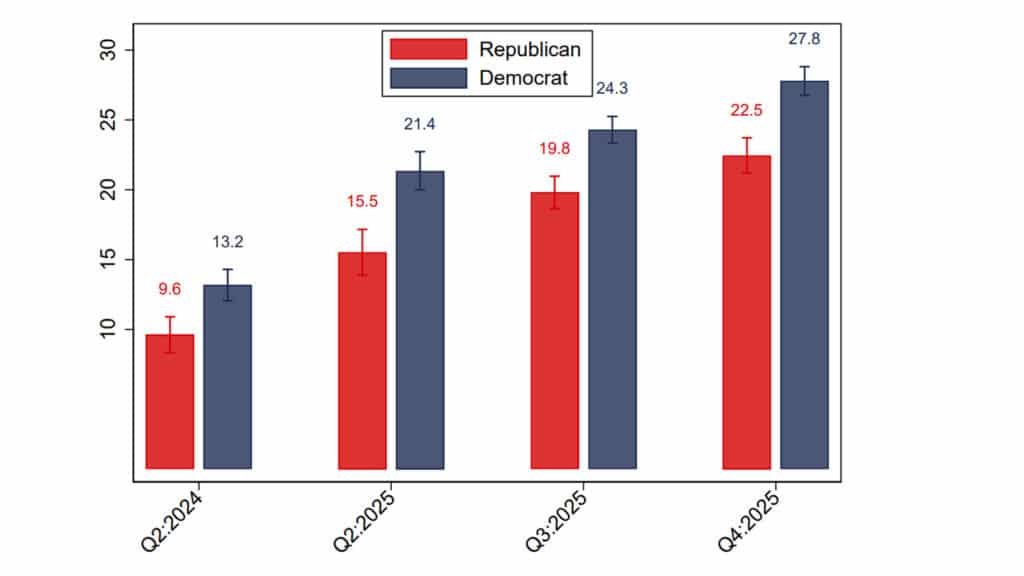
The study finds a consistent «partisan gradient» in workplace AI use. By the fourth quarter of 2025, 27.8% of Democrats reported using AI weekly or daily, compared with 22.5% of Republicans. Beyond frequency, Democrats also showed deeper integration of the technology into their workflows, using AI for 16% more work activities than Republicans. This broader use is reflected in a higher «AI Productivity Index,» which measures task-level integration such as generating ideas and consolidating information.
Education and occupation as key drivers
However, the researchers emphasize that the gap is not driven by political ideology or a perceived leftward bias in AI tools. Instead, it reflects a «political geography» shaped by education and professional sectors. Democrats in the study were significantly more likely to hold a college degree — 57% compared with 30% of Republicans — and more likely to work in tech-oriented or professional roles with higher natural exposure to large language models. When researchers controlled for education, industry and occupation, the partisan gap in AI use disappeared.
Shared concerns about job displacement
The study also found that concern about the future is bipartisan. Differences in perceived job-displacement risk were modest and not statistically significant, with about 14.1% of Democrats and 13.1% of Republicans believing their roles could be eliminated by technology within five years. Despite this shared concern, Democrats reported more supportive workplace environments, including firms more likely to integrate AI tools and communicate clear strategies for their use.
Structural inequality, not ideology
The authors conclude that because AI currently complements high-skill, highly educated roles, its economic benefits may inadvertently reinforce existing partisan divides. Ultimately, the «politics of AI» reflects less of a red-versus-blue divide over technological progress and more of structural inequality in access to the education and industries most prepared for automation.