

During the Muslim fasting period, the number of Google searches for «namaz» (prayer) rises significantly, while interest in intimate services declines, according to Kazakh data scientist Nurasyl Abrazakuly.
Nurasyl examined the widely held view that the focus on spiritual growth during the holy month of Ramadan is reflected not only in people’s behavior but also in their online search activity.
Read also: What is ‘halal gaming’? Inside the YouTube niche with millions of fans.
Using Kazakhstan as a case study, he compared Google Trends data for searches for «namaz» and «kyzdar net,» a popular website that advertises intimate services.
The analysis found that searches for «namaz» increase sharply in the period leading up to Ramadan. At the same time, interest in sex-related services declines before and during the fast, then rises again after Eid al-Fitr (known locally as Oraza Ait), the holiday marking the end of Ramadan.
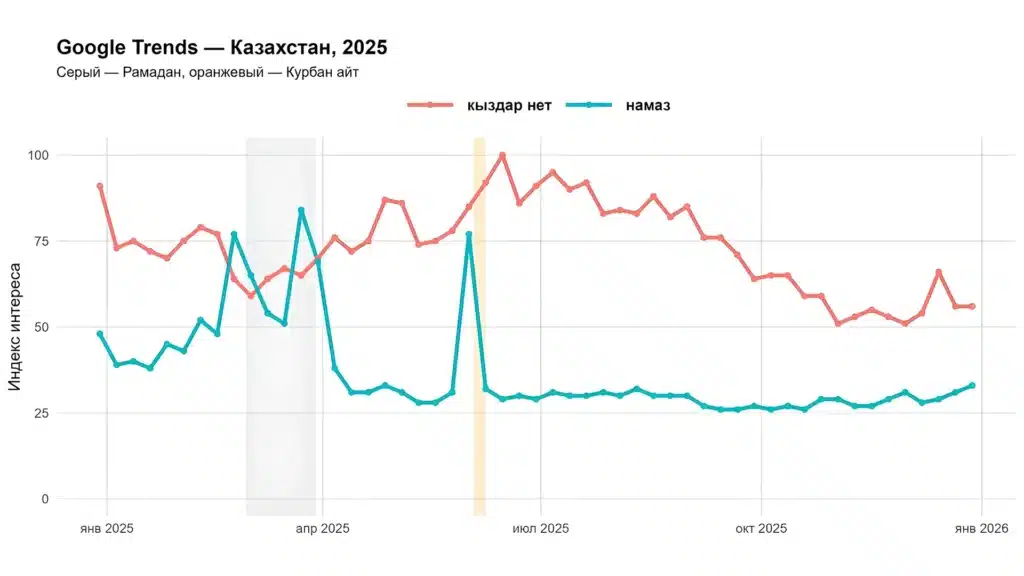
A similar pattern of growth and decline appears around Eid al-Adha (Kurban Ait), the festival of sacrifice that marks the end of the Hajj pilgrimage.
The findings support the hypothesis that periods of religious observance and celebration can influence online search behavior in predominantly Muslim countries.