
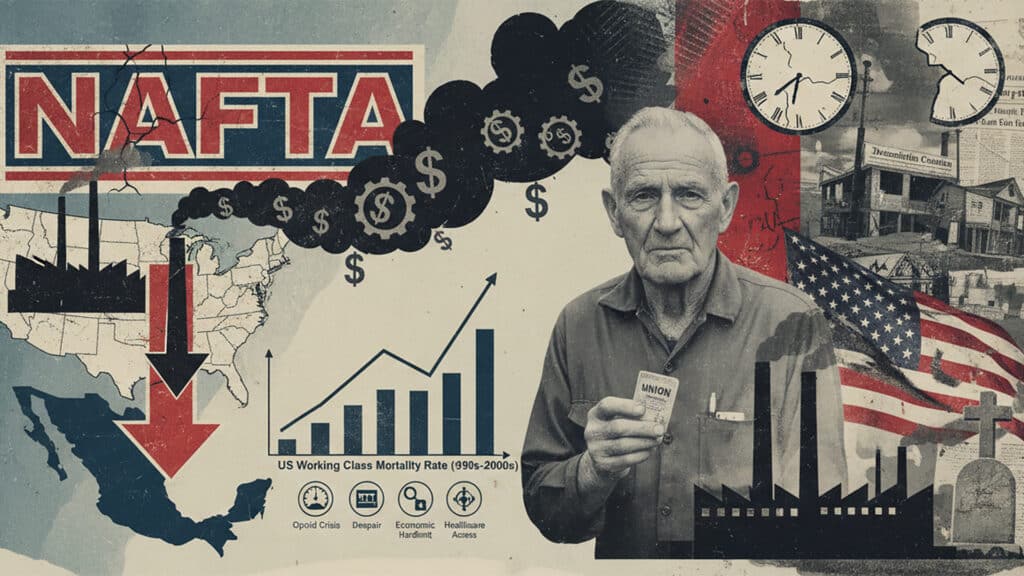
The North American Free Trade Agreement (NAFTA) had a profound and overlooked impact on American health. The study, recently published by the National Bureau of Economic Research (NBER), suggests that the restructuring of the U.S. economy following the 1994 agreement led to a measurable increase in mortality rates among the working-age population.
Trade shocks and health crises
The researchers found that areas with high exposure to trade competition from Mexico experienced a 2.1 percent rise in mortality among adults aged 25 to 55. For the specific «treated» population — those who actually lost their jobs due to the agreement — the impact was even more severe, with an estimated 7.3 to 7.6 percent increase in mortality. These findings are based on a comprehensive analysis of the universe of U.S. death records from 1980 to 2010.
Read also: New study finds ‘significant link’ between poor nutrition and depression.
The study identifies several economic mechanisms that translated trade shocks into health crises. Highly exposed regions saw sharp, permanent reductions in income and employment, particularly within the manufacturing, textile, and apparel sectors. This economic distress led to a 19 percent reduction in housing price indices and a significant decline in homeownership. Furthermore, displaced workers frequently lost access to private health insurance, forcing a shift toward presumably lower-quality public insurance.
Not a ‘death of despair’
A notable finding of the study is the specific nature of these deaths. Unlike the «China shock» literature, which often focuses on «deaths of despair» such as drug overdoses, NAFTA’s impact was largely driven by internal causes. Specifically, the researchers documented significant increases in deaths from cardiovascular diseases, health-behavior-related cancers (linked to increased smoking and alcohol consumption), and suicide. These effects were primarily concentrated among white individuals in the working-age bracket.
Read also: Unstoppable? Why trade wars fail to dent China’s industry.
The authors conclude that the aggregate welfare benefits often attributed to trade liberalization frequently omit these «hidden costs» to human health. The study highlights a critical failure in the social safety net, noting that programs like Unemployment Insurance and Trade Adjustment Assistance proved insufficient to protect the long-term health of workers in communities devastated by industrial decline.