
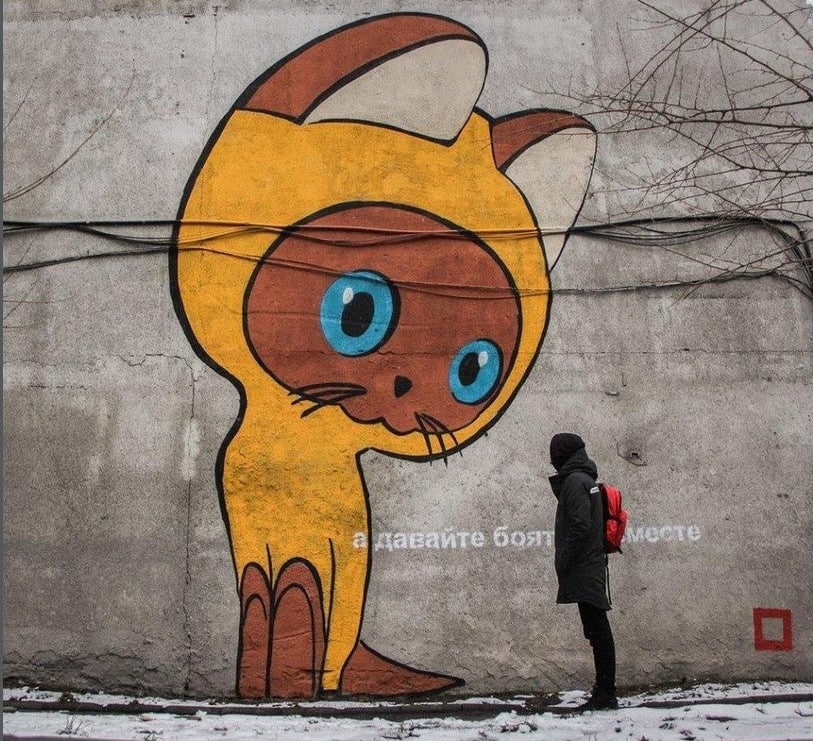
When the famous work «Let’s Be Scared Together!» by Kazakh artist Pasha Kas disappeared from the wall of a building in downtown Almaty in January 2025, residents reacted as though they had suffered a personal loss.
Outraged comments flooded social media:
«Who could have been bothered by a kitten named Gav?» «Gray walls for a gray city.» «Make Almaty Grey Again.»
Some people even recalled bringing out-of-town visitors specifically to see the mural.
Twenty years ago, such a reaction would have been difficult to imagine. At the time, graffiti was widely regarded as vandalism. Today, tourists travel around the world to see famous murals and street art, use them as meeting points, and rally to protect them with the same passion often reserved for historic landmarks.
The last Saturday in June is celebrated as National Mural Day. Here are some of the world’s and Kazakhstan’s most iconic murals.
«Love Is in the Air» («The Flower Thrower»)
Artist: Banksy
Created: 2003
No contemporary artist has done more to popularize street art than the elusive British artist Banksy. His works appear without warning and quickly become global news. They are removed from walls — sometimes with the surrounding masonry intact — sold at auction for millions of dollars and, even when destroyed, continue to hold iconic status.
Among Banksy’s many celebrated works, «Love Is in the Air,» also known as «The Flower Thrower,» stands out as perhaps his most recognizable image. It depicts a masked protester poised to throw what appears to be a rock or a Molotov cocktail. Instead, he is holding a bouquet of flowers.
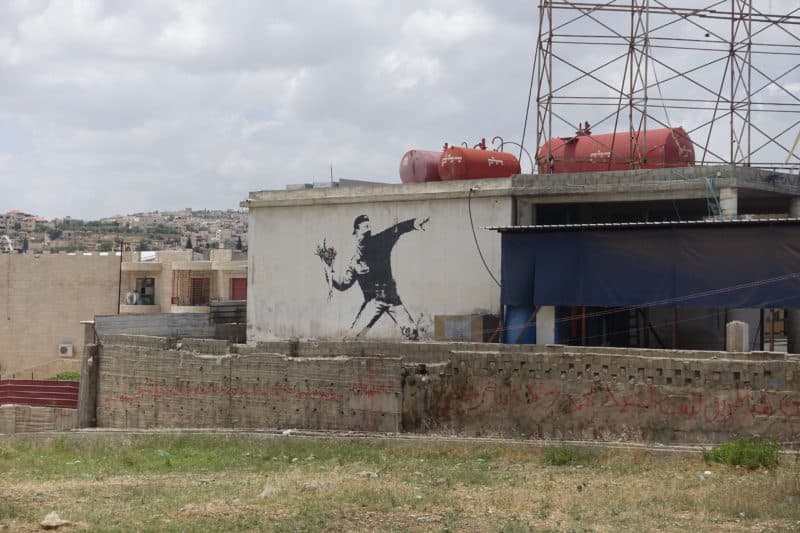
The mural has become one of the defining images of contemporary art. It has been reproduced on exhibition posters, book covers, clothing and countless other items. It also recalls the ideals of the 1960s anti-war movement, when protesters embraced slogans such as «Flower Power» and «Make love, not war,» sometimes placing flowers into the barrels of soldiers’ rifles as a symbol of peaceful resistance.
«My God, Help Me to Survive This Deadly Love»
Artist: Dmitri Vrubel
Created: 1990
«It was a disgusting, revolting sight,» artist Dmitri Vrubel once said of the famous photograph that inspired his mural.
The image, taken during celebrations marking the 30th anniversary of East Germany in October 1979, showed Soviet leader Leonid Brezhnev embracing and kissing East German leader Erich Honecker.
«At first I almost threw up,» Vrubel later recalled. «But, as often happens, I wanted to capture in art what could not be captured in that photograph.»
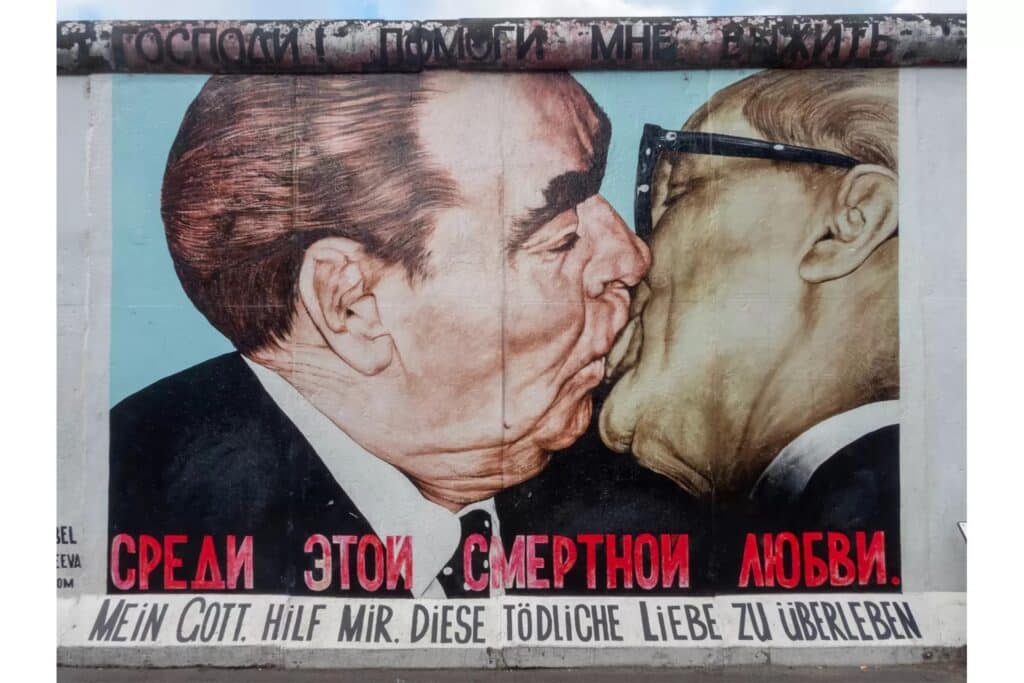
Those sketches evolved into one of the best-known murals on the Berlin Wall. Today, the painting is among the defining works of the East Side Gallery, the open-air gallery created along one of the longest surviving sections of the wall.
Art historians describe it as one of the most enduring images of the Berlin Wall’s legacy, while it has become an essential stop for visitors to Berlin.
«Dream of a Sunday Afternoon in the Alameda Central»
Artist: Diego Rivera
Created: 1947
If the Berlin Wall symbolizes the political upheavals of the 20th century, then Mexico City is home to a mural that tells the story of four centuries of Mexican history.
«Dream of a Sunday Afternoon in the Alameda Central» originally decorated the dining room of the Hotel del Prado, overlooking the city’s oldest public park, Alameda Central. After the devastating 1985 earthquake, the hotel was deemed beyond repair, but the wall containing the mural was carefully removed, restored and transferred to the Museo Mural Diego Rivera, where it remains on display today.
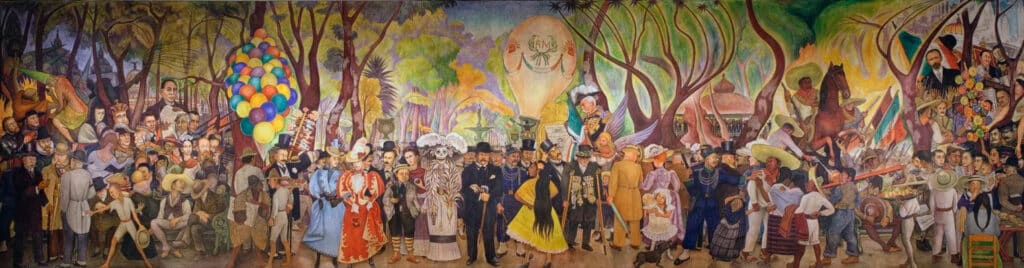
At first glance, the painting appears to depict an ordinary Sunday in the park. In reality, it is a sweeping panorama of Mexican history.
Rivera brought together more than 150 historical figures spanning the country’s past, from the Spanish conquest to the Mexican Revolution. Among them are conquistador Hernán Cortés, President Benito Juárez, revolutionary Francisco I. Madero, artist Frida Kahlo, Rivera himself as a child, and, at the center of the composition, La Catrina — the elegant skeletal figure created by engraver José Guadalupe Posada that has become one of the most recognizable symbols of Mexican culture. In the mural, La Catrina is shown holding the young Rivera’s hand.
«We Dance»
Artist: Pasha Kas
Created: 2016
One of the most thought-provoking works of Kazakh street art is «We Dance,» a mural painted by Pasha Kas on the facade of a five-story apartment building in Temirtau. Inspired by Henri Matisse’s iconic painting «Dance,» the mural transforms a classic masterpiece into a powerful commentary on modern industrial society.
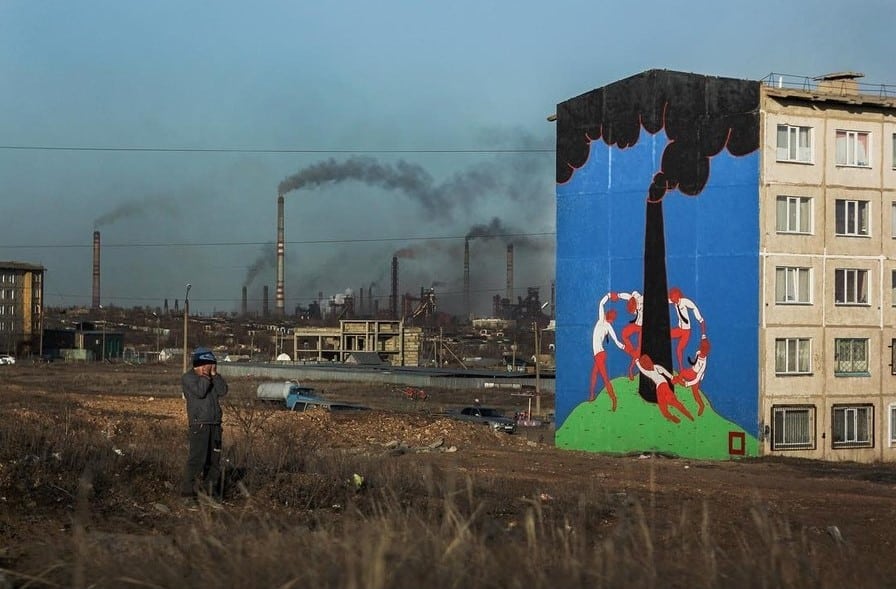
While Matisse’s five nude figures holding hands symbolize harmony between humanity, nature and the primal forces of life, Kas reimagines the composition as something far more unsettling. His dancers, dressed in white shirts and black ties — symbols of the corporate world — circle a smoking industrial chimney. The mural replaces the mythical center of Matisse’s composition with a monument to industrial civilization built on resource extraction and corporate power. The dance continues, but its meaning has changed.
«Monster corporations, ready to suck up and sell off the oil, are painting new interiors. We’re desperately dancing around the pipeline!» the artist wrote on Instagram.
The choice of location was as significant as the artwork itself. Temirtau, one of Kazakhstan’s most heavily industrialized cities, has long faced complaints about air and soil pollution. When unveiling the mural, Kas cited environmental research highlighting the city’s ecological problems.
«Metallurgical plants are destroying all life at its roots. Not long ago, environmentalists collected soil samples from five playgrounds and found lead concentrations five times above the permissible level. Everyone remains silent!» he wrote.
City authorities responded almost immediately. While officials did not criticize the mural’s message, they said it had been painted without the required permit, noting that any alterations to the exterior of residential buildings must receive prior approval.
«Waiting» («Grandmother With Binoculars»)
Artists: Saule Suleimenova and Kuanysh Bazargaliev
Created: 2019
The story of another celebrated Almaty mural is equally revealing.
«Waiting» — better known to many residents as «Grandmother With Binoculars» — was created by Saule Suleimenova and Kuanysh Bazargaliev during Mural Fest in 2019. Depicting an elderly woman alongside her two grandchildren, the triple portrait quickly became one of the city’s most beloved public artworks.
Then, during facade renovation work, it was painted over.
Read also: Why Almaty’s famous Dimash mural was painted over.
Its disappearance sparked widespread public outcry. Residents discussed the loss across social media and in local media, calling for the mural to be restored. Eventually, the artists’ work returned to the building in almost exactly its original form.
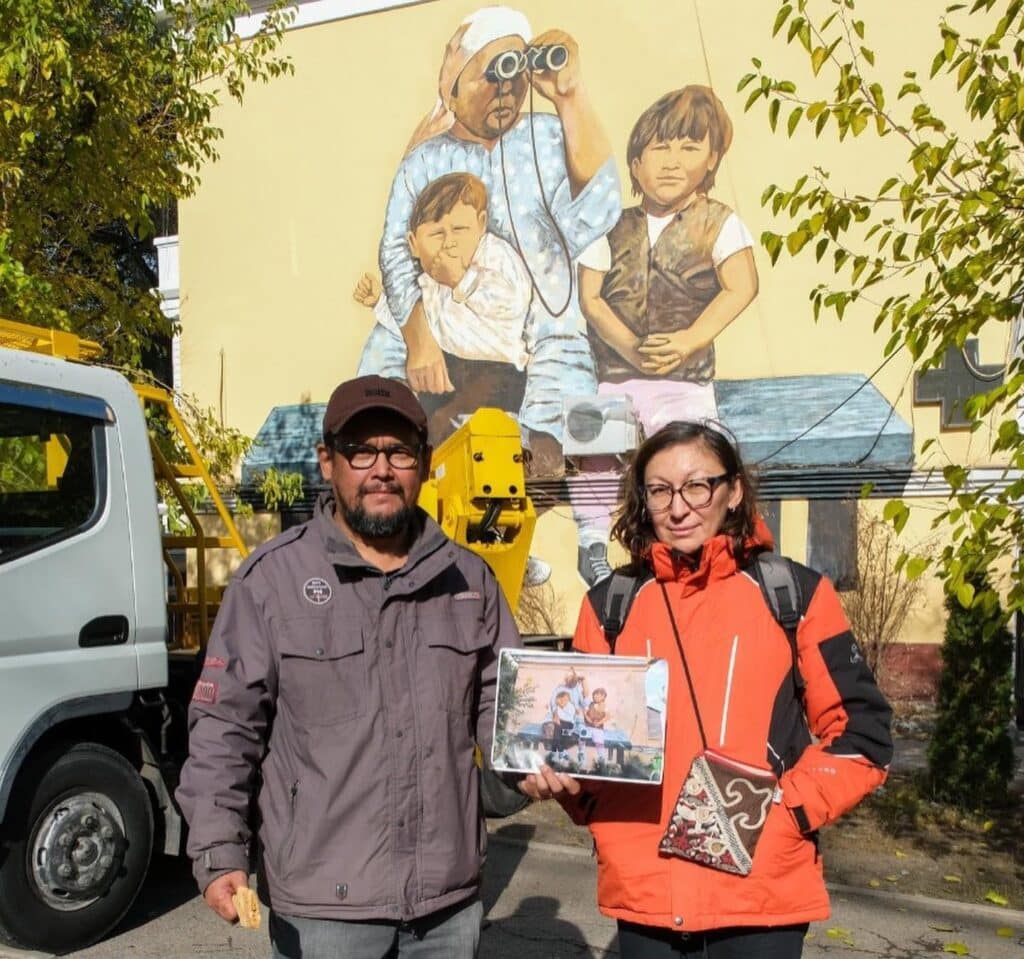
«Yesterday, @kuanysh_bazargaliev climbed the wall and brought the children back to life. Now we can say the mural’s restoration is complete,» Suleimenova wrote on Facebook on Nov. 3, 2022.
Urban memory painted on walls
The history of murals continues to unfold before our eyes.
A new artwork may appear tomorrow on the side of an ordinary building, initially provoking debate before gradually becoming part of the city’s identity. A few years later, it may become a landmark where tourists stop for photos and friends arrange to meet.
Perhaps that is how urban memory is sometimes created — painted onto the walls of everyday buildings.