



Official communications from the National Bank of Kazakhstan are becoming increasingly difficult to understand. Readers need an education equivalent to that of a university student or graduate to easily comprehend the regulator’s press releases on its base rate, according to a report by the Applied Economics Research Centre (AERC).
Readability has fallen to the level of academic texts
The AERC analyzed the evolution of the National Bank’s communication strategy, drawing on research by a central bank staff member (Meirmanova, 2024). The findings indicate that the language used in official documents has become progressively more complex.
The Flesch readability score for base rate press releases fell from 41.5 in 2019 to 36.4 in 2023, indicating that the texts became harder to understand. Meanwhile, the Flesch-Kincaid grade level rose from 12.8 to between 13.6 and 14.1. On this scale, readers would need approximately 14 years of formal education to understand the regulator’s statements.
The report offers a striking comparison based on calculations by J. Fulwood, a Bank of England official. Understanding most news articles or literary works by renowned authors requires no more than 10 years of education. A lecture by Nobel laureate physicist Richard Feynman explaining the Heisenberg uncertainty principle requires just eight years. By contrast, central bank communications require 14 years of education.
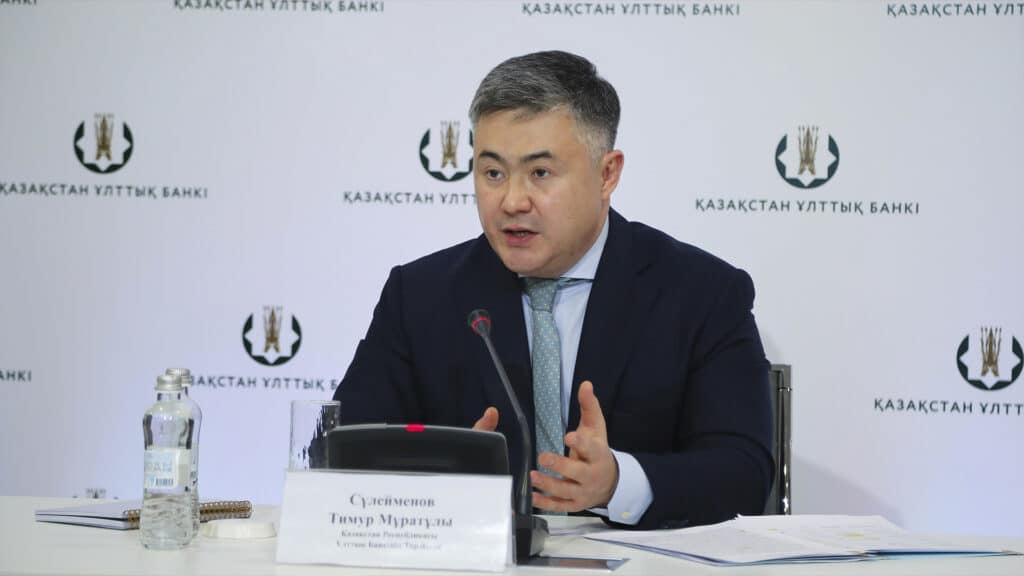
Read also: Kazakhstan’s central bank may sharply cut base rate by late October.
The analysts note that as the National Bank’s reports have become more complex, they have grown harder for the general public to understand. At the same time, the regulator’s statements have become less effective at shaping citizens’ inflation expectations.
Progress for professionals, a communication gap for the public
The AERC analysts also point to significant institutional progress made by the National Bank since Kazakhstan adopted inflation targeting in 2015. Before the transition, public communication was largely limited to occasional press releases and comments on the tenge exchange rate.
In recent years, the National Bank has introduced regular press releases explaining the rationale behind its base rate decisions, launched a Monetary Policy Report, established a social media presence, revamped its website and begun holding briefings and interviews with senior officials.
Between 2020 and 2022, the regulator also introduced elements of «forward guidance,» signaling the likely direction of interest rates to financial markets.
In 2025, the National Bank began publishing summaries of discussions held by its Monetary Policy Committee, offering greater insight into the reasoning behind its decisions.
Read also: Risky business: Kazakh housing bank chief compared to Venezuela’s Maduro.

Banks and large corporations have learned to interpret these signals and incorporate them into their lending and deposit rates, the AERC notes. However, communication with ordinary citizens remains underdeveloped. The National Bank focuses much of its outreach on professional financial market participants, while the general public tends to overlook its extensive analytical articles and reports.
Information gap may contribute to elevated inflation expectations
Because official reports are primarily accessible to specialists and the media landscape is saturated with discussions of fluctuations in the tenge exchange rate, public inflation expectations remain elevated — 3 to 4 percentage points above the actual inflation rate, according to the report.
In its Monetary Policy Strategy through 2030, the National Bank has pledged to improve transparency and explain the reasoning behind its decisions more clearly.
The AERC experts argue that to help curb inflation, the regulator needs to move away from complex, convoluted language and adopt a more direct, accessible communication style. Shorter explanations and infographics could help the public better understand monetary policy decisions and their implications for household finances.
