

According to Freedom Holding Corp. CEO Timur Turlov, the company relies on big data and machine learning when estimating insurance costs. By using AI, analyzing traffic camera data and parsing court decisions, it is possible to determine responsibility for accidents occurring at different times of day. This allows Freedom to offer cashback of up to 40% to low-risk drivers, giving it a competitive advantage over insurers that cannot segment risks as accurately. The businessman revealed this while speaking to students at Stanford.
Last summer, the Stanford Graduate School of Business released a case study on Freedom Holding Corp.’s digital ecosystem. Designed for MBA students, the case study examines the company’s strategy, business model, management decisions, Nasdaq listing, launch of IT products, internal transformation and the creation of a digital ecosystem.
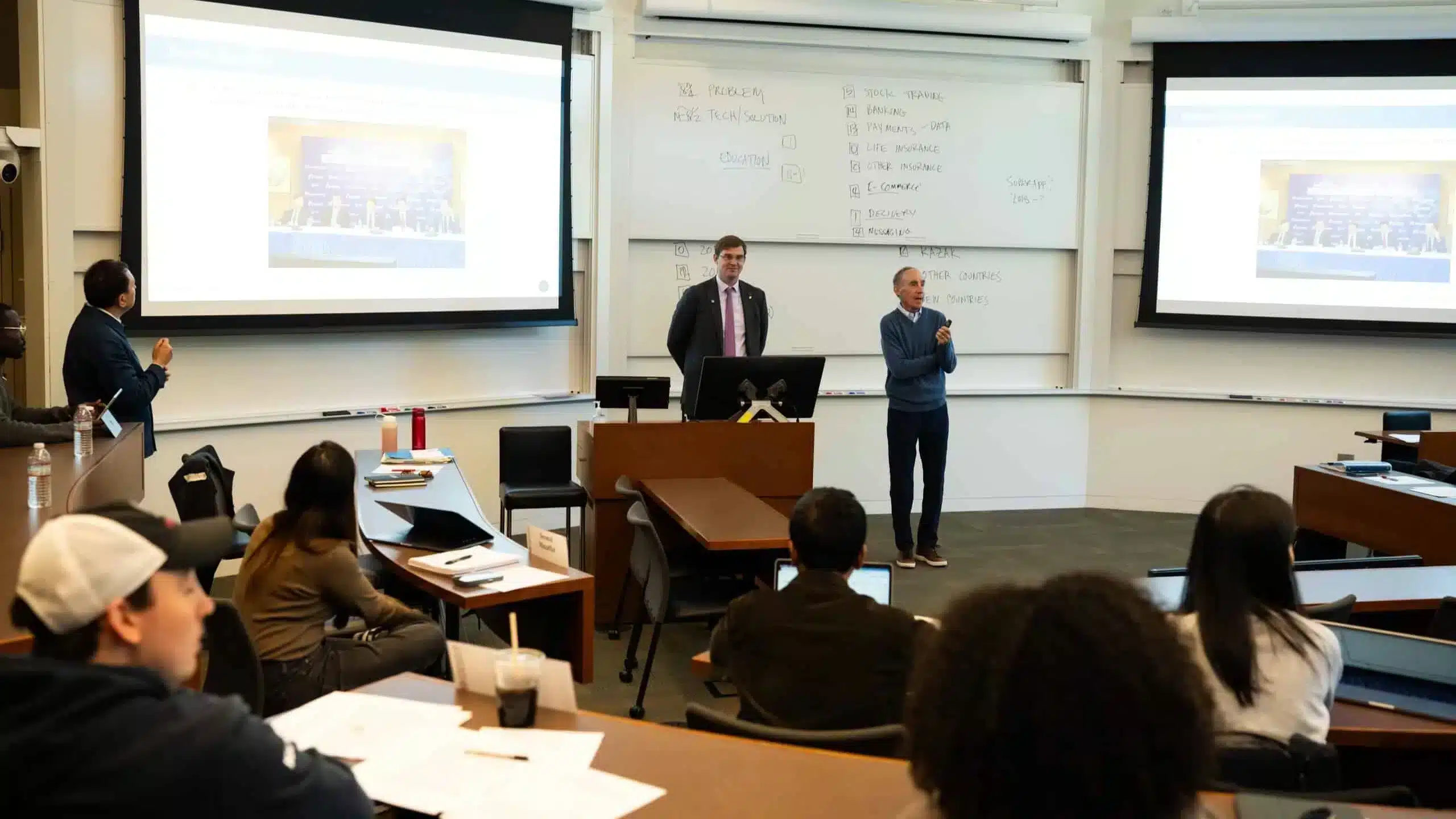
A year later, on May 26, Timur Turlov took part in an open seminar at Stanford dedicated to the Freedom Holding Corp. case study. During the first part of the session, students analyzed the case study together with their professor, after which Turlov joined the discussion. He answered participants’ questions and spoke about the development of the Freedom ecosystem. During the meeting, he shared examples of the company’s digitalization achievements, ranging from processing an online mortgage in four hours to making Freedom Bank the leading bank in Kazakhstan by Mastercard payment volume in just 18 months.
Analysis of court decisions and the «digital footprint» of accidents
As Turlov explained, in order to create an effective insurance model, the company went far beyond the standard review of bank statements.
«We conducted a comprehensive analysis of various court decisions: who was at fault in different incidents, where they occurred and at what time of day. (…) Analyzing this data alongside our clients’ credit histories often provides a much more accurate assessment of risk,» the Freedom Holding Corp. CEO noted.
He elaborated that the company achieved this by combining open data from administrative accident reports with internal databases, creating a «data lake» that enables it to assess risk more accurately than traditional insurers.
«The cost of risk varies greatly and we’ve begun to understand the true cost of risk for each vehicle. Now we can offer low-risk customers cashback of up to 40% and conversely charge higher premiums to high-risk customers,» Turlov said.
Boosting the ecosystem’s attractiveness
During a discussion of the Freedom case study, Stanford University Professor Howard Rosen explained to his students that data is crucial not only for risk assessment but also for customer retention in a competitive marketplace.
According to him, key metrics include customer lifetime value (LTV), customer acquisition cost (CAC) and the ratio of daily active users to monthly active users (DAU/MAU).
Timur Turlov confirmed that integrating all data into the SuperApp has increased customer retention in lifestyle services fivefold, from 5% to 25%. This is because the company stores user and family data in a single system, allowing one-click transactions without repeated verification (KYC).
«I’ve realized how incredibly valuable data is. To be successful in a market where no one knows anything, you need to be digital in everything,» Turlov emphasized.
In February 2026, Freedom Insurance CEO Azamat Kerimbayev said in an interview with Kursiv.media that the number of registered insurance claims in Kazakhstan has been growing rapidly. According to him, while approximately 110,000 accidents were reported in 2023, the figure rose to 137,000 in 2024 and reached 167,000 in 2025.
The increase is attributable less to a rise in the number of accidents than to drivers more frequently reporting even minor collisions through official channels.
Kerimbayev also noted that the European Accident Statement (EAS), which Freedom Insurance has actively promoted in Kazakhstan, has already become an industry standard. In major cities, approximately 35% of accidents are reported through the EAS, reducing the burden on both the police and the judicial system.