

Kazakhstan’s President Kassym-Jomart Tokayev has signed a comprehensive new law regulating psychological activities, marking a historic shift in how mental health services are managed and monitored in the Central Asian nation. The «Law on Psychological Activity,» enacted July 2, 2026, establishes the first rigorous legal framework for the profession, ranging from mandatory state registration to strict ethical boundaries for online practitioners.
The legislation arrives as part of a broader state effort to ensure «psychological well-being» — defined by the law as a state of emotional stability and the ability to overcome difficult life situations — while weeding out unqualified practitioners from an increasingly crowded market.
Standardizing the «psychologist» title
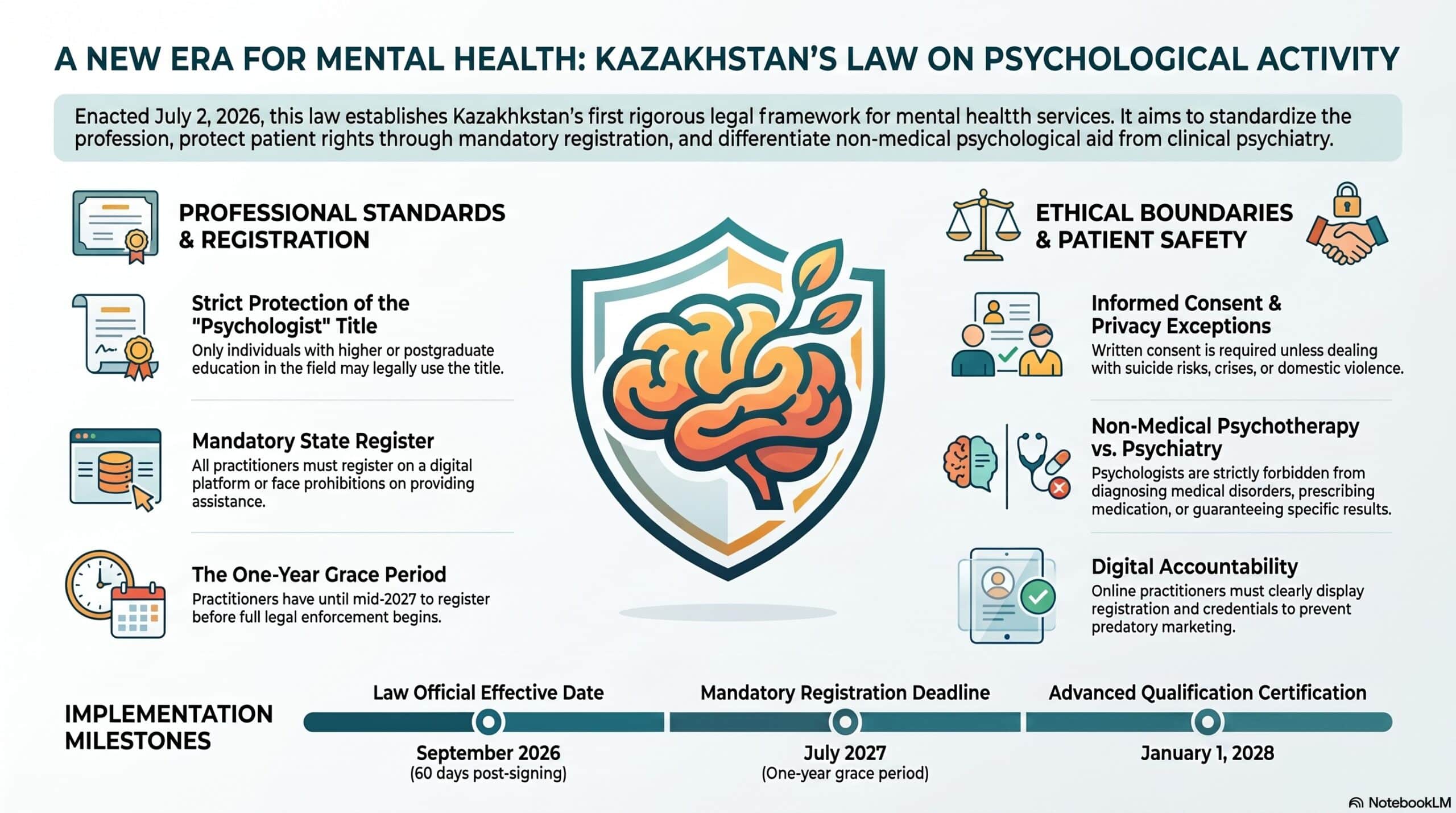
One of the most significant pillars of the new law is the creation of a mandatory State Register of Psychologists, which will be hosted on a digital platform within the national qualifications system. Under the new rules, the title of «psychologist» is strictly reserved for individuals with higher or postgraduate education in the field.
The consequences for remaining outside this system are severe. Individuals not registered in the state database are expressly prohibited from providing psychological assistance or even calling themselves «psychologists.» Furthermore, the law bans unregistered individuals from using any derivative terms or titles starting with the prefix «psycho-» that could mislead the public regarding their professional status.
Privacy and the crisis exception
The law places a high premium on «professional secrecy,» mandated as information obtained during therapy that cannot be disclosed without the recipient’s written consent. Central to this protection is the requirement for «informed consent» — a written agreement between the provider and the client before any services begin.

However, the legislation carves out critical exceptions for public safety. Informed consent is not required in cases involving signs of suicidal behavior, circumstances indicating a person is in a crisis, or evidence of domestic violence. In these high-stakes scenarios, psychologists are legally obligated to notify relevant authorities immediately if there is a direct threat to the life or health of the client or a third party.
Defining non-medical psychotherapy
The law introduces a clear distinction between medical psychiatry and «non-medical psychotherapy.» The latter is defined as a specialized form of psychological aid aimed at overcoming difficult life situations and improving emotional states without treating behavioral disorders that require medical intervention.
To practice non-medical psychotherapy, psychologists must undergo additional specialized training and complete a period of supervised practice. The state will also implement a «Code of Ethics,» a unified set of behavioral rules that all practitioners must follow regardless of their specific niche.
Digital oversight and online platforms
Recognizing the rise of digital therapy, Article 19 specifically targets the «Wild West» of social media and online consulting. Psychologists operating via online platforms are now legally required to display their state registration details, educational credentials, and professional qualifications clearly.

The law also warns that placing «false information» while advertising or practicing through online platforms will result in legal liability. This move is intended to protect consumers from predatory marketing and «miracle» cures often found on social media.
Professional bans and restrictions
The legislation sets firm boundaries to prevent psychologists from overstepping into the medical field. Practitioners are strictly forbidden from performing medical diagnoses, prescribing medication, or using psychoactive substances that influence human consciousness.
Furthermore, psychologists are prohibited from guaranteeing specific results to their clients — a common tactic in deceptive advertising. If a psychologist identifies symptoms of a mental or behavioral disorder that requires medical attention, they are legally required to refer the client to a psychiatrist.
Implementation and timeline
The law is set to take effect 60 days after its official publication, though practitioners have a one-year grace period to complete their mandatory registration in the state database. A more advanced «certification» process, intended to further verify professional qualifications, is scheduled to launch on Jan. 1, 2028.