

It turns out that sheep teeth are a time capsule, helping scientists track how medieval Kazakhs altered their lives to match a merciless climate. An international team of researchers led by scientists at the University of Michigan analyzed the enamel of sheep molars recovered from the archaeological site of Zhankent.
Ancient tooth enamel offers clues
The study found that the inhabitants of the ancient city of Zhankent carefully managed their flocks to ensure a year-round supply of milk and dairy products.
Located in southern Kazakhstan, Zhankent was an important city on the northern branch of the Silk Road during the ninth and 10th centuries. Until now, however, researchers had only a limited understanding of how its residents secured reliable food supplies despite hot summers, cold winters and an arid climate.
Livestock strategies supported year-round food production
Isotopic analysis of the animals’ tooth enamel showed that Zhankent’s inhabitants relied on several livestock management strategies. They stored hay to feed sheep during the winter, acquired some animals from other regions, and managed breeding so that lambs were born at different times of the year.
These practices ensured a steady supply of milk and dairy products throughout most of the year.
«Mouth of the Open Sky,» an installation by Kazakh artist Zoya Falkova. In the installation, the teeth of sheep, cattle and humans are intertwined, reflecting the inseparable relationship between people and livestock in the Kazakh steppe. With its multiplying reflections evoking an infinite steppe, the piece becomes a reflection on memory and the enduring trauma of a famine driven by Soviet collectivization and forced settlement.
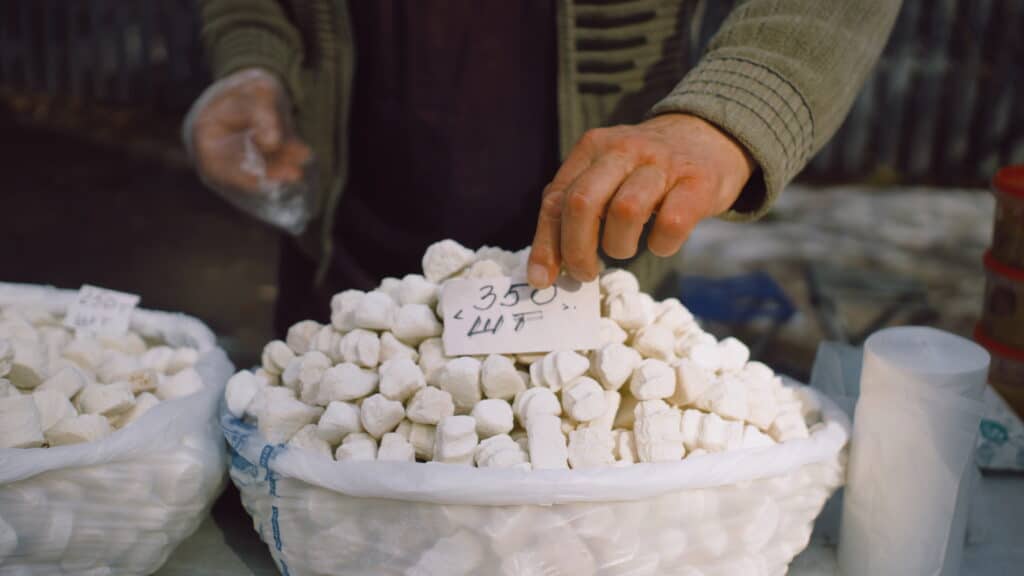
According to the study’s authors, this approach helped the community withstand periods of food scarcity. Residents were also able to produce and store kurt — dried fermented cheese balls with a long shelf life that remain a staple of Kazakh cuisine.
The researchers concluded that the diversity of Zhankent’s livestock management practices made the city more resilient to challenging environmental conditions and helped it flourish as a major trading center along the Silk Road.