


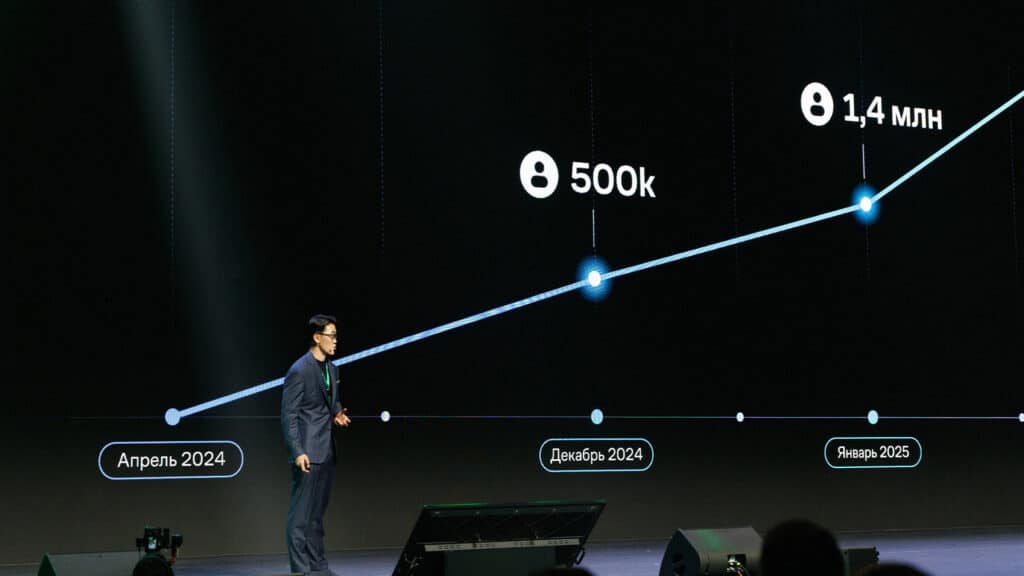
Two years ago, Freedom launched its SuperApp with mobile banking as the core element. Since then, it has expanded into dozens of other services — from travel and shopping to telecommunications and government services — and its user base has grown to 6 million. As a result, the SuperApp team faces a new challenge: how to integrate all those services into intuitive user scenarios while constantly creating new ones.
In an interview with Kursiv, Freedom SuperApp CEO and Managing Director of Freedom Bank Vyacheslav Kim discussed the evolution of modern banking, managing a rapidly growing ecosystem and maintaining startup-like momentum in a conservative industry reliant on digital infrastructure.
From audience growth to depth of engagement
– The SuperApp has managed to grow to 6 million users in two years. What’s next?
– Last year, we grew tenfold. This year, we gained another 1.5 million users. Today, the SuperApp hosts over 20 services and 45 offerings — ranging from banking products and investments to travel, shopping, telecom and government services. Yet our greatest achievement is the trust of those 6 million users.
Our focus is now shifting from scale to depth of engagement. When an app offers dozens of options, the main challenge is ensuring users don’t have to search manually for the service they need. That is why our two key priorities right now are Smart Offering and hyper-personalization. By leveraging customer data, we aim to offer the right service or specific deal at the exact moment a user truly needs it.
We focus on analysing user behavior. We see which features people use, what works for them and what needs adjustment. This lets us refine the customer journey, make communications more relevant and gradually phase out features that deliver no value.
Banking products remain the SuperApp’s core, powering payments, authentication, data management, and the loyalty program. Moreover, they enable us to integrate diverse services into seamless user journeys. For instance, imagine someone planning a trip. Within a single app, they can buy a ticket, arrange insurance and activate an eSIM.
In the future, the SuperApp will offer users exactly what they need, rather than being a one-size-fits-all storefront. So one user might focus on travel, another on investments and a third on everyday financial products. For example, we are currently undertaking a major overhaul of our investment section to make investing significantly simpler and more accessible to a broad audience.
Long story short, the goal of personalization is very simple: to shorten the path from a user’s need to its solution.
– What changes when millions of people are already using the product?
– Fundamentally, our approach to the product hasn’t changed: we’ve always strived to make well-considered decisions and take responsibility for the outcome. However, when nearly 6 million people use the product, the stakes of every decision are much higher. Even a minor change can impact a massive audience.
That’s why, as we scale, our processes are becoming more systematic. There are more pre-release checks, clearer areas of responsibility, and more rigorous risk management and change control. What once relied heavily on the attentiveness and engagement of specific individuals is now part of a structured system.

At the same time, we’re trying not to swing to the other extreme. Large scale shouldn’t mean the company becomes slow or afraid to experiment. We should maintain speed and an entrepreneurial mindset while minimizing the human factor’s impact on product quality.
Ultimately, product maturity isn’t about the absence of errors. For me, it’s the ability to maintain speed, quality and accountability while providing services to millions of users.
How dozens of services become one SuperApp
– How do you maintain control when there are dozens of services within the SuperApp?
– When there are many services, you can’t manage them simply as a collection of separate products. Yet every service in our ecosystem is essentially a standalone company, with its own team developing the product independently. However, within the SuperApp, each service is integrated according to unified standards that cover everything from the user journey and interface to analytics and communications.
The SuperApp team’s role is to provide this methodology and expertise while constantly challenging our partners. We view the product through the user’s eyes, identifying where we can eliminate unnecessary steps, clarify workflows, boost conversion rates or improve integration with other services. In other words, we don’t just accept finished products into the SuperApp; we work alongside the teams to continually identify growth opportunities.
We are currently consolidating this practice into a unified product layer at the holding company level, encompassing shared standards, tools, a design system, analytics and principles for managing the customer journey. The goal is not to add an extra layer of approvals, but to give companies ready-made expertise and tools, enabling them to develop products faster and more independently.
A key element here is regular communication across all divisions. While teams remain autonomous, they work toward a single objective: regardless of which service users access, they should enjoy a consistent, intuitive and seamless experience within the SuperApp.
– How do you determine which service will be added to the SuperApp next?
– A new product must either address a high-demand use case or logically complement an existing one. For instance, the eSIM service doesn’t operate in isolation; it’s part of the travel journey, alongside tickets, insurance and other services.
The second criterion is the service’s potential within the ecosystem. We evaluate how the service connects with other products, how often a user might return to it, and whether we can improve its convenience by leveraging SuperApp capabilities — such as single sign-on, integrated payments, data sharing and loyalty programs.
Finally, we validate everything with the numbers. We analyze conversion rates, retention, usage frequency, the user journey and customer churn. If a service is in demand, we look for ways to scale it and link it to other use cases. If the data suggests otherwise, we modify the product or rethink its role within the SuperApp.

– Which of the new services has integrated most seamlessly into the user journey?
– One great example is eSIM. The product was launched within the SuperApp with virtually no external advertising, yet it quickly gained a customer base. We saw strong growth in this area because the service organically solves a real user need. It’s convenient for a user to purchase an eSIM while planning a trip, stay connected abroad, and simultaneously maintain access to essential banking and other services.
This product was well chosen and integrated into an existing workflow. It can grow organically — without massive external ad campaigns — because it appears exactly when the customer needs it. This is where the ecosystem really proves its value: an individual product doesn’t have to acquire an audience from scratch because the SuperApp is already a platform with millions of users.
The eSIM service also illustrates how the role of banking apps is evolving. Users no longer come solely for financial transactions; the bank has become part of a broader everyday routine.
– Banking is becoming invisible. Could banking apps disappear altogether?
– I’d say it’s not banking itself that will disappear, but rather the perception of it as a distinct activity. People still need to make payments, transfer money and use cards and credit. But increasingly, a financial transaction is becoming just one part of a broader task.
A person might be buying a ticket, ordering groceries, paying for parking, or taking out insurance; meanwhile, the bank — operating in the background — handles the payment, authorization, security, data and loyalty program. The user doesn’t need to think about the financial side of the process.
So, the bank’s role isn’t diminishing; it’s evolving. The less users notice banking in their daily routine, the better it’s working. Its role isn’t shrinking — quite the opposite, it’s becoming more profound. The bank is transforming into an infrastructure layer that connects various aspects of everyday life.
Managing a product without getting in the team’s way
– How do you stay involved with the product without turning into a micromanager?
– I believe you can’t step away from day-to-day operations entirely. If you don’t use the product yourself — if you don’t see what’s being launched, where users are struggling, or how the market is shifting — you very quickly lose touch with what’s actually happening.
At the same time, making every single decision yourself is both impossible and wrong. Our job is to build strong teams, give them sufficient autonomy and create a system where decisions are made quickly without the leader’s constant involvement.
For me, it’s all about balance. You need to understand the product well and stay close enough to spot a problem early or ask the team the right questions. But if work grinds to a halt without you, the system isn’t set up correctly.
– How do you manage to keep up with such an intense pace?
– Probably because I genuinely enjoy what I do. In this case, work doesn’t just end at a specific time. You might leave the office, but you keep thinking about the product, new ideas and what could be improved. That’s why I don’t believe in the classic concept of work-life balance.
At the same time, it is essential to switch gears. Exercise helps me a lot: My mind works completely differently after a workout. I also try to set aside time for myself and my loved ones. Saturdays are almost always dedicated to my family. On Sundays, I try to go to church and work out. To me, that’s what balance is all about: not trying to perfectly separate work and life, but finding time for the things that give you energy.