
Smart city: How Almaty cemented its lead in Central Asia with the launch of Jerry

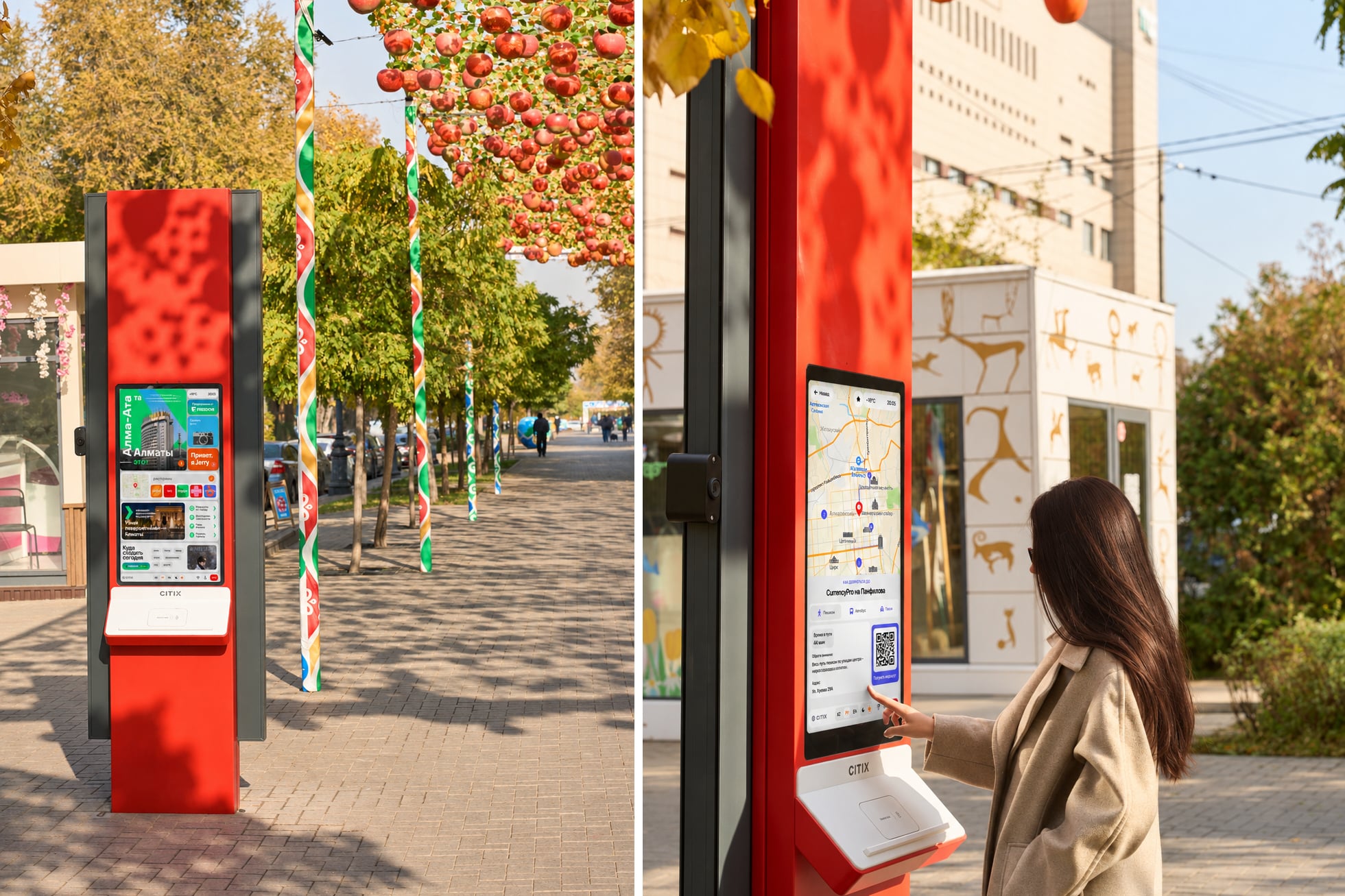
Almaty has rolled out Jerry, a network of pedestrian smartboards that act as a new kind of digital street assistant. We look at why the launch reinforces the city’s standing as the region’s smart city capital – and what makes the model unique.
In early November, Jerry arrived on Almaty’s pedestrian streets: a smart city assistant that brings navigation, a city guide, an events listing, air-quality data and emergency calling together in one place. Thirty-one smartboards are up and running at launch, with four more due to go live shortly. They can be found on Panfilov Street, outside the Palace of the Republic, in 28 Panfilov Guardsmen Park, and along the Terrenkur health trail and the city’s embankments. Jerry is free to use, requires no registration and works in Kazakh, Russian and English. The project was delivered by CITIX in partnership with Visit Almaty.
Behind the product lies a bigger story. Jerry’s launch is a clear signal that Almaty is consolidating its role as Central Asia’s smart city capital, as technology moves out onto the street and becomes a service that any resident can use.
Why Almaty
The choice of city is backed by the numbers. Almaty remains one of Kazakhstan’s most digitally advanced cities: more than 96 per cent of public services are delivered online, and research firm ThoughtLab ranks it among Asia’s ten leading metropolises for digital transformation readiness. The city has its own Smart City strategy, and the launch comes as Kazakhstan marks 2026 as the Year of Digitalisation and Artificial Intelligence, declared by Kassym-Jomart Tokayev, President of the Republic of Kazakhstan.
Against this backdrop, the city also has an economic driver: tourism. In 2025, Almaty welcomed around 2.5mn visitors, 754,000 of them from abroad. That growing flow needs a digital point of entry, and Jerry is built directly into the fabric of the city – with no need to download yet another app.
What Jerry can do
Jerry is designed as an assistant you can ask about the city in the here and now. It knows where you are standing and plots a route from that very spot: it shows the nearest cafés, pharmacies and bus stops, journey times, and walking or public-transport directions, then sends the result to your phone via a QR code. It also offers curated routes, hand-picked places to visit and a city events listing that links straight through to tickets. A dedicated safety section includes an SOS button for calling the emergency services, as well as guidance for foreign visitors on where to turn for help and how to find embassy or consulate contacts if they lose their documents.
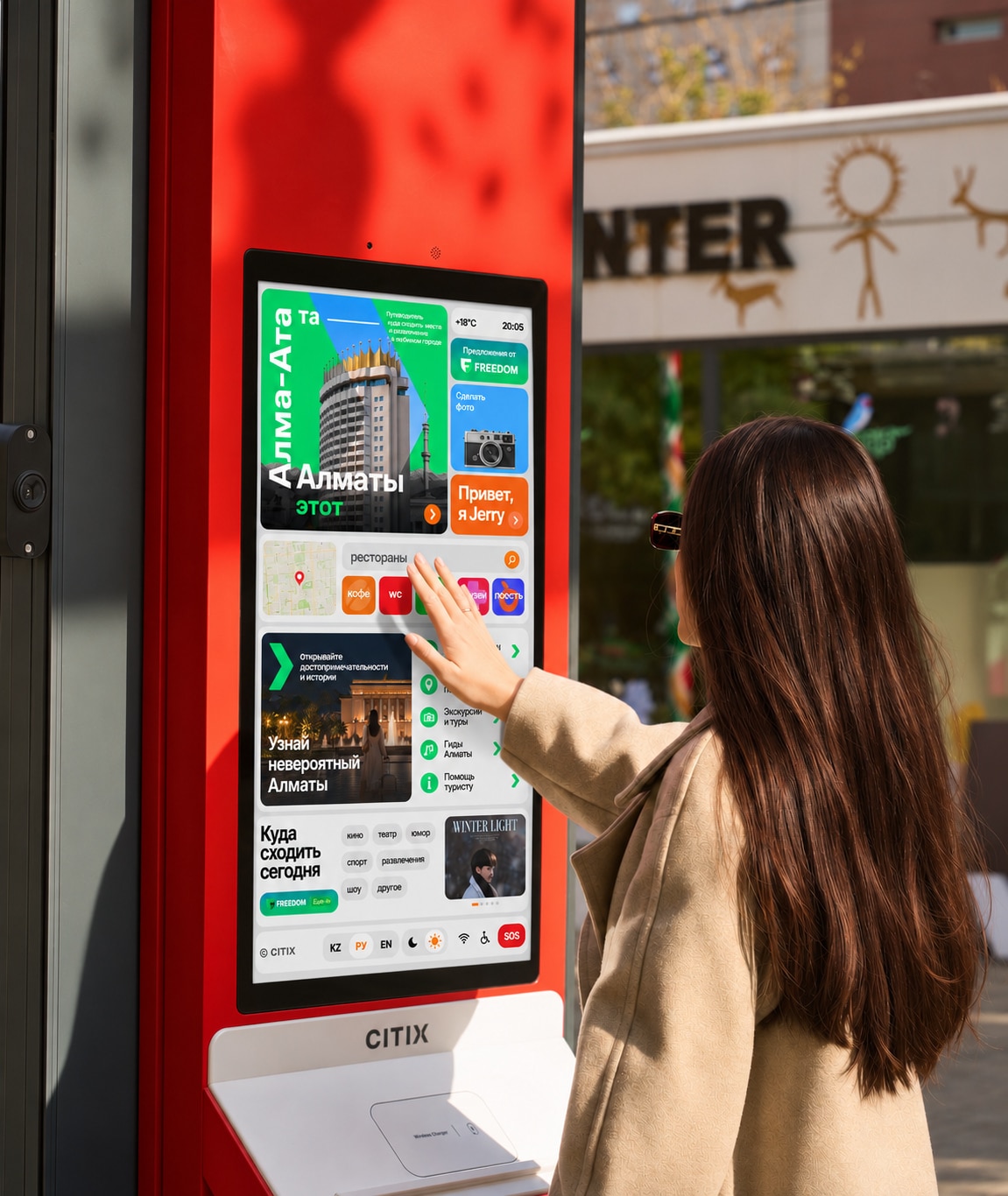
The device also displays the weather forecast and air quality, a feature developed in collaboration with Air Initiative. The cultural layer comes courtesy of «Alma-Ata Then, Almaty Now», a special project by CITIX and Qalam Media: standing in front of the screen, passers-by can now see what the city looked like decades ago. Archival photographs from the Central State Archive are paired with contemporary shots of the same locations, taken specially for the project.
What makes the format unique
Individual elements of this kind of solution can be found in capitals around the world, but taken together – smart city services, a city guide, tourist infrastructure, safety, environmental data and cultural heritage, all in a single trilingual street assistant – the format is one of a kind. And the key difference lies not so much in the feature set as in the economics behind it.
CITIX operates at the intersection of smart city technology and adtech, and has been refining this model for several years. Its formats are already familiar to the cities it works in: large-format Big Screens and Tom smartboards along major roads, where widgets for city services sit naturally alongside commercial content. Advertising revenue funds the integration of the company’s own smart city solutions. Jerry extends that logic to people on foot: a distinctive urban device designed for those who have paused to strike up a conversation with the city. The public-service component is paid for by advertising revenue rather than taxpayers’ money – Jerry costs Almaty’s city budget nothing.
What it means for the city
For Almaty, the benefits work on several levels. Tourists gain a digital point of entry and can navigate the city like locals, which means their attention is channelled purposefully – towards nearby sights and venues. Jerry’s city guide features curated selections of small businesses close by, so the growing tourist flow translates into revenue for local SMEs, street by street. Safety and an intuitive urban environment boost the city’s appeal to visitors, particularly those travelling from further afield. And the very presence of working digital infrastructure on the street strengthens Almaty’s image as a tech-forward city.
«Technology feels closer when it helps people at a specific moment – when you need a tip on where to go, your phone has died, or you suddenly need an ambulance. The technologies we develop in advertising allow us to fund city services like these without drawing on the public budget,» says Gotsa Oligova, CEO of CITIX.
Every day, the city asks its own small questions – where to go, how to get there, where to find help – and now the answers are right there on the pavement.
