
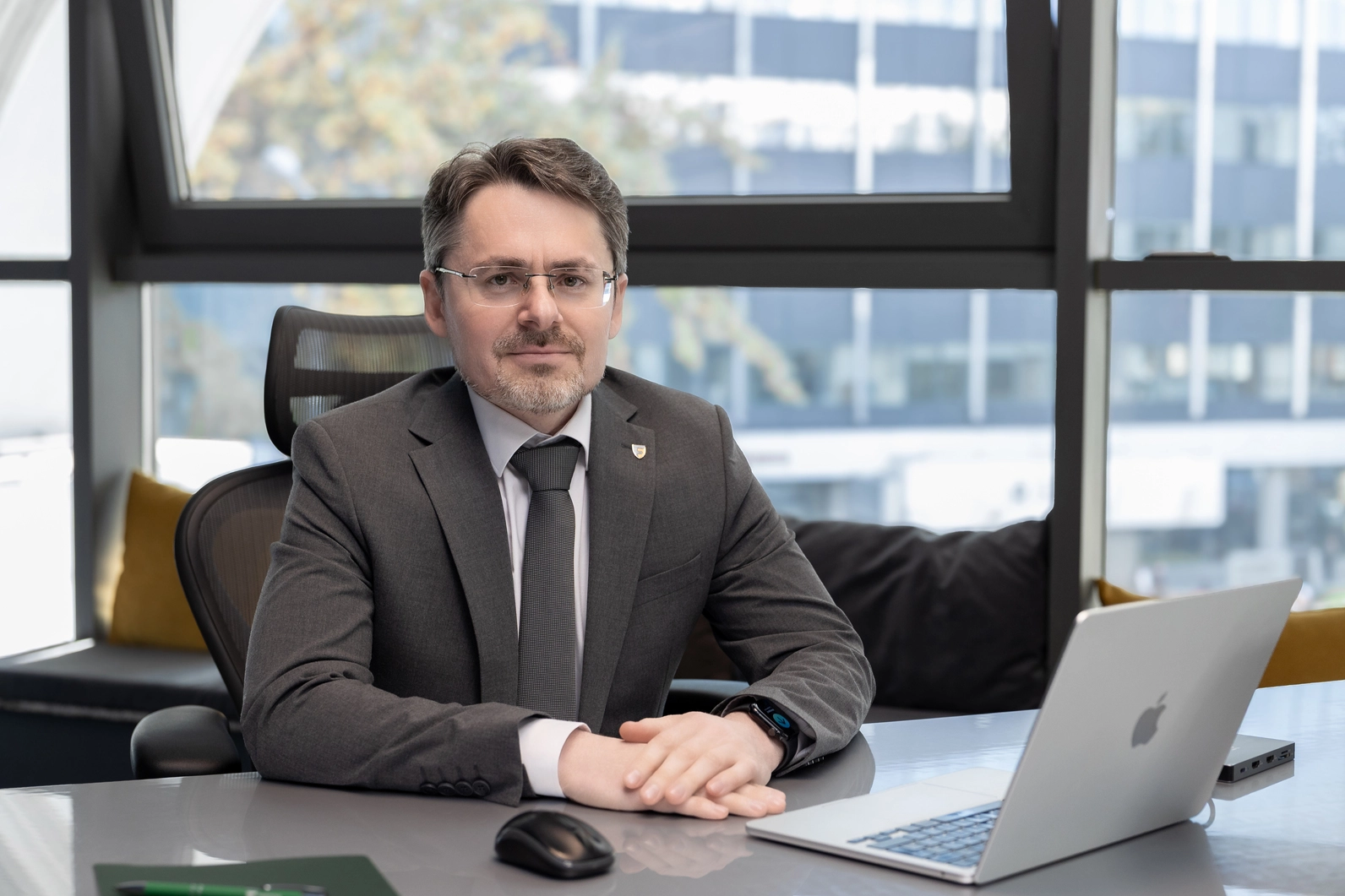
‘Simple for Customers, Complex for Company’: Head of Freedom Group of Companies, Payments Division on Fintech Routine
Just a few years ago, people perceived Freedom Payments, also known as PayBox, primarily as a traditional online acquiring service. Today, it is an infrastructure platform that processes more than 12 million transactions a month and is actively expanding beyond Kazakhstan into Uzbekistan, Kyrgyzstan and Tajikistan. Even though the company is part of a large parent holding company, almost all of its business comes from external clients. In this interview, Head of Freedom Group of Companies, Payments Division Roman Minikeyev explained why the Freedom ecosystem needs a separate payment service alongside Freedom Bank, how artificial intelligence helps fend off cyberattacks and why smartphone payments — simple on the surface — rely on highly complex processes that remain invisible to users.

When you joined PayBox in 2021, it was primarily an online acquiring service. What is Freedom Payments today? Where does acquiring end and a full-fledged payment infrastructure begin?
In 2021, PayBox was indeed primarily associated with online acquiring. Today, Freedom Payments is a much broader payment infrastructure platform for businesses.
Acquiring remains one of our core business areas, but our role is no longer simply to accept payments on websites and process transactions. We now cover many more stages of the payment process, including various payment methods, recurring payments and tokenization, payouts, online fiscalization, payment links, QR payments, mobile wallets and other solutions.
In addition, we are developing infrastructure products for banks and major partners, including processing, payment gateways, card issuance and multi-acquiring.
The dividing line is roughly where a company stops being merely a payment acceptance service and starts managing the entire payment chain. Today, Freedom Payments is a technology partner that helps businesses not only accept payments but also build payment and fintech infrastructure around their specific needs.
Freedom has its own bank. Why does the ecosystem need a separate payments company? What functions do you perform that cannot simply be transferred to the bank?
Freedom Bank and Freedom Payments have different roles, which is precisely why it makes sense to develop them as separate businesses.
The bank primarily handles financial products: accounts, cards, lending, banking services and customer relationships. Freedom Payments has a different set of responsibilities. It provides the technology infrastructure for payment acceptance and processing, transaction routing, tokenization, fraud prevention and integration with payment systems.
Moreover, Freedom Payments isn’t limited to a single bank’s infrastructure. We can work with different banks, fintech companies and payment systems. Multi-acquiring is a good example: through a single integration, a business can work with several acquiring banks simultaneously, while payments can be routed between them according to predefined rules. If this platform were moved entirely into Freedom Bank, it would primarily become banking infrastructure. It is important for Freedom Payments to remain an independent technology layer capable of serving the entire market.
Having Freedom Bank within the ecosystem gives us additional opportunities. We can integrate banking and payment products more deeply and move faster from idea to finished solution.
For example, we can combine payment acceptance with business banking products, develop more sophisticated payout, tokenization and card-service scenarios, and create solutions at the intersection of acquiring, installment payments and other financial products. In this case, businesses receive an integrated payment solution rather than a collection of separate services from different providers.
That is why the value lies in combining these two areas of expertise.
What volume of payments does your company process?
We process around 12.5 million transactions per month, although this volume can fluctuate significantly. It depends primarily on our merchants’ activity, but external circumstances also play a role. For example, when other payment services experience outages, some customers may turn to us to process their payments. That is why we must not only handle current transaction volumes but also be prepared for sudden spikes in demand, ensuring that payments remain just as reliable as they are on a normal day.

How dependent is Freedom Payments on large merchants?
Large merchants are certainly important to Freedom Payments, and we value our long-term relationships with them. However, I wouldn’t say we are heavily dependent on individual clients. We work with companies across various industries, and the flexibility of our services allows us to consider their specific needs and adapt our solutions accordingly.
We also approach our relationships with merchants primarily as partnerships. We focus on understanding how a client’s business is developing, what it needs and where our solutions can add value. Our expertise, combined with continuous improvements in technology and processes, helps us strengthen cooperation with existing clients and identify new business opportunities.
We have already experienced significant changes in our merchant portfolio. Markets do not stand still: demand, operating conditions and legislation change. That is why we must not assume our customer base will remain unchanged but adapt our offerings and approaches on time. Our team knows how to operate in such conditions.
Of course, we value every long-term partnership and invest in developing these relationships. But for us, business resilience means a combination of strong customer relationships, a diversified portfolio and the ability to respond to market changes.
What share of your business comes from the Freedom holding company, and what share comes from external clients? Is there a risk of becoming merely an internal infrastructure provider?
Today, the vast majority of Freedom Payments’ business comes from external clients.
Therefore, we do not see a risk of becoming an internal payment infrastructure provider for the ecosystem. Freedom Payments is developing as an independent payments business operating in the open market. The Freedom ecosystem provides additional opportunities for joint projects and new product launches. Still, external companies remain the foundation of our business, ranging from small and medium-sized enterprises to major partners.
Which products within the Freedom ecosystem benefit most from your infrastructure?
The companies within the ecosystem that benefit most from Freedom Payments’ expertise and infrastructure are those that need to launch payment solutions quickly, accept payments and scale these solutions across different markets.
Overall, we provide companies within the holding group with several complex capabilities at once: online acquiring (including local payment systems, Apple Pay and Google Pay), recurring payments, QR payments, alternative payment methods, fraud prevention and payment orchestration.
If a Freedom company needs a new payment solution, we do not have to start from scratch. We already have the technology platform, integrations, team expertise and understanding of regulatory requirements. This significantly shortens the time it takes to move from an idea to a pilot project.
Another important benefit is international scalability. Freedom Payments already works with payment infrastructure in several countries, so solutions developed within the ecosystem can potentially be adapted and replicated in other markets where Freedom operates.

Why should an external bank or fintech company buy processing services from you instead of building its own?
Building an in-house processing platform is possible, but it requires enormous resources. Beyond developing the platform itself, you need integrations with payment systems, certifications, security, fraud prevention, monitoring, fault tolerance and a team to maintain it around the clock.
Freedom Payments provides banks and fintech companies with ready-made infrastructure they can launch quickly and scale as needed. This includes acquiring, card issuance, tokenization, digital wallets, fraud prevention and payment gateways. Our partners do not have to spend years building all of this on their own. They can focus on their products and customers while we help them scale their technology.
So we basically compete with the cost and time a bank would have to invest in building its own infrastructure, rather than with other processing providers.
How large could your B2B business become?
For us, Freedom Payments has long been more than just an online acquiring service. We have extensive expertise in payment processing, and historically this business has served not only the ecosystem but also external clients, including banks and fintech companies.
Today, as the bank within the holding company grows, some of that expertise naturally focuses on the ecosystem’s needs. However, the B2B potential remains significant. We address a wide range of needs, from acquiring and card issuance to payment gateways and processing. Our experience with external clients shows strong market demand for this expertise.
That is why B2B remains a sustainable business area for us. We are developing our own ecosystem while maintaining opportunities to work with external partners.
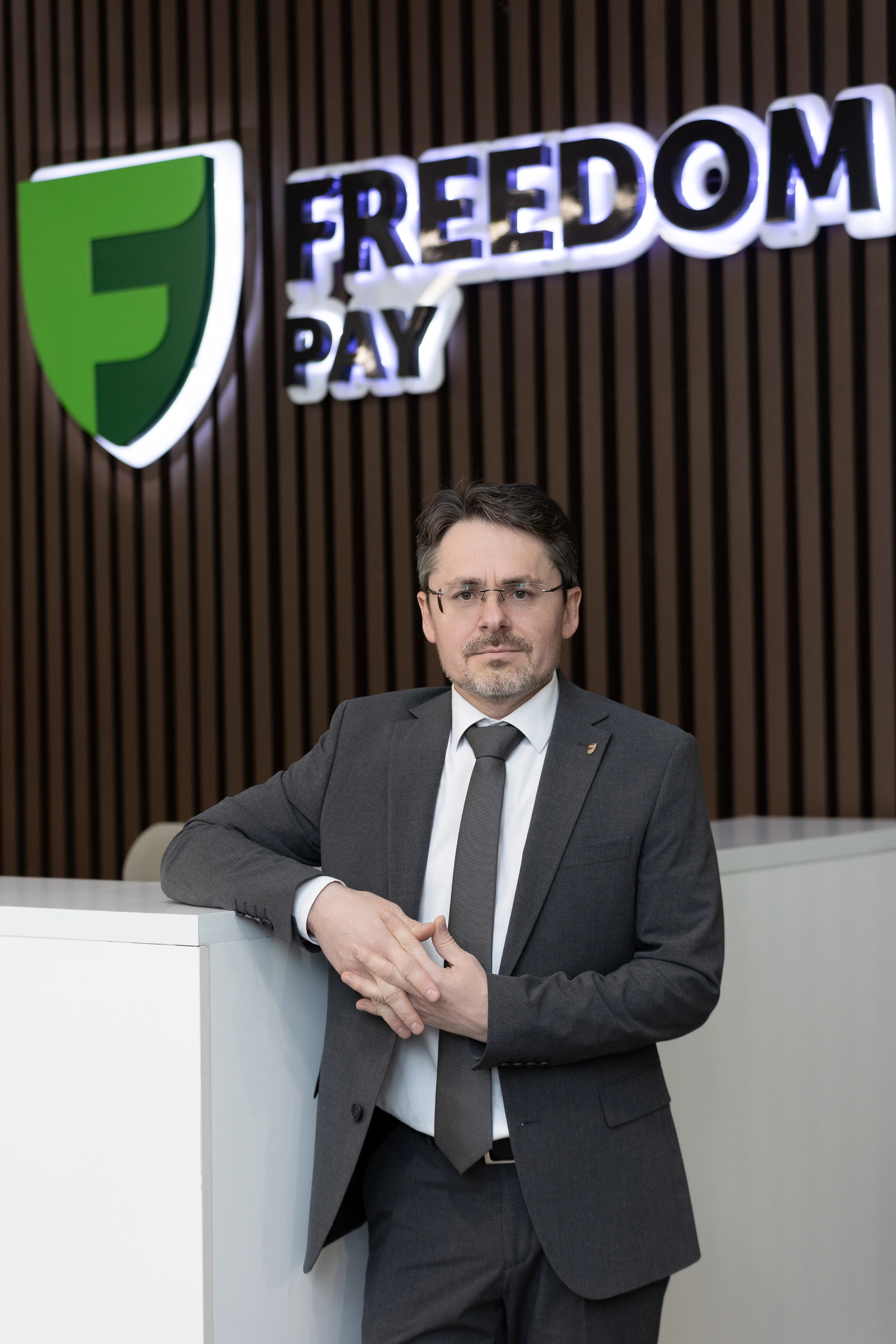
What are the most significant cybersecurity risks today?
Given our transaction volumes, cybersecurity directly affects business resilience, customer trust and the company’s share price. Over the next year, we are focusing on three areas.
First, we are protecting digital services and integrations with banks, merchants and partners. We are strengthening access controls, building redundancy into critical components and ensuring round-the-clock system monitoring to maintain payment availability and reliability.
The second priority is ensuring secure development. The speed of product launches must not come at the expense of security. That is why we are introducing automated checks of code and software components to identify vulnerabilities before they affect customers and the business.
The third area involves threats associated with AI. Cybercriminals are also using new technologies, so we are developing anomaly detection mechanisms, strengthening data controls and improving the security of our AI-powered solutions.
Security is embedded in every stage of our operations, from service design to infrastructure management. We regularly undergo independent assessments and evaluate the results using specific metrics: service availability, the speed of threat detection and remediation, audit findings and compliance with industry requirements.
For us, cybersecurity investment is not simply a mandatory expense. It is an essential condition for growth. Customers need to be confident that their payments are secure, partners need to trust the reliability of our platform, and investors need to be assured of the business's resilience.
What is your payment approval rate?
As for the success rate, Freedom Payments maintained a rate of approximately 96% from January 2025 through mid-October 2026, excluding user errors. This is one of our key acquiring metrics because it directly reflects the stability of the payment process and the quality of the entire technology chain.
At the same time, we look not only at the technical side of a transaction but also at the entire user journey. A good example is the updated payment page, which we rolled out more broadly in June 2026. We initially tested the new version with companies within the holding group the previous year. We analyzed user behavior, refined the interface and tested different payment scenarios.
Once the solution demonstrated consistent results, we began rolling it out to other merchants. As a result, the updated payment page increased successful payment conversion by 18%.
For us, this is a good example of how acquiring efficiency depends on several factors: processing stability, the quality of the technology infrastructure, interface usability and how easily users can complete the entire payment process.
That is why, even with a success rate of 96%, we continue working to reduce system errors and improve every stage of the payment process to increase the share of completed transactions for our merchants.
Your website says you operate in Kazakhstan, Kyrgyzstan and Uzbekistan. What about Tajikistan, and which other markets are you planning to enter?
Historically, Freedom Payments has had a presence in three key markets for quite some time: Kazakhstan, Kyrgyzstan and Uzbekistan. These countries are an important part of our geographic footprint, partly because they are in demand among international clients. Many of these clients work with us in several markets simultaneously.
Earlier this year, we also began actively expanding into Tajikistan. Freedom Payments has already established a legal presence in the country, and we are now building a local team and working to obtain the necessary payment license. In other words, Tajikistan is no longer merely a potential market for us but the next stage of our business development in the region.
At the same time, we view international expansion as part of developing the entire Freedom ecosystem, particularly in cooperation with Freedom Bank. For us, entering a new market means more than simply establishing a legal entity. We also need to understand what infrastructure we can build there, what needs we can address within the ecosystem and how attractive that market is to our existing and potential international clients.
Turkey is one of the markets we are currently focusing on. We are exploring the possibility of establishing a legal entity and deploying processing infrastructure there. At the same time, we are assessing opportunities to enter the Georgian market.
Overall, several factors are important when selecting new markets: the Freedom ecosystem’s development plans, interest from international clients, regulatory specifics and the ability to build sustainable local payment infrastructure.
So our goal is not simply to increase the number of countries on the map. We want to gradually build interconnected payment infrastructure in markets where we can both support the development of the Freedom ecosystem and enable our clients to work with us across several countries.
Do you use AI in your operations? If so, how?
We definitely do. AI is already capable of significantly transforming a wide range of processes at Freedom Payments, and for us, this is not something belonging to the distant future. We already use these technologies and are gradually expanding their applications.
Today, AI is used in several areas. In software development, it helps create new solutions faster, automate internal processes and improve team productivity. In IT, it accelerates incident investigations by collecting and analyzing large volumes of data, helping identify known software vulnerabilities.
In customer support, AI makes it possible to find similar incidents, relevant instructions and potential solutions more quickly. We also use it to prepare documents, presentations and reports, from structuring information to visualizing ideas and key performance indicators.
Another area we are currently testing is an intelligent knowledge base. Our goal is to enable employees to quickly find the information they need from both internal company sources and external resources. This is particularly important for new employees. Instead of spending a long time searching across different systems, they can quickly find information about products, processes, operating procedures and internal requirements.
The next stage is deeper integration of AI directly into our products and operational processes. We are considering using these technologies to analyze transactions and detect anomalies in merchant operations.
Another promising area is a personal AI assistant for employees: a single interface for interacting with corporate systems, through which employees can report an incident, send a message, perform a routine task, arrange a meeting or obtain the information they need.
We are also considering a transition to more flexible business processes in which the next steps are determined not only by a predefined workflow but also by specific events and context.
And, of course, we see considerable potential in customer service. In the future, a universal AI chat assistant could transform the way we interact with merchants by answering questions faster, helping them use our products and resolving a significant share of routine issues without lengthy waits for support.
For us, AI is primarily a tool for improving the speed and quality of work. Our goal isn’t simply to automate individual tasks but to gradually embed AI into company processes so employees can spend more time on complex, genuinely valuable work.
Your team is behind all these products and technologies. How is it structured today?
At present, our team is divided fairly evenly. The structure naturally changes as the business grows. Functions that were previously part of another unit are being separated into independent departments or divisions. For example, last year we established a separate Operations Department.
Has your understanding of what makes a good employee changed in recent years?
I would say it has not so much changed as expanded. Soft skills, emotional intelligence and an environment of trust remain relevant and are becoming even more important. At the same time, the ability to learn quickly and adapt has become particularly valuable. We see how rapidly new technologies are becoming part of everyday work. That is why a strong employee needs not only knowledge but also the ability to keep learning, adapt and apply new things in practice.
For us, a strong employee is not simply someone who does their job well. It is someone who takes responsibility, shows initiative, critically evaluates information and achieves results with the team. An environment of trust helps these qualities flourish. In such an environment, people are willing to ask questions, suggest ideas, share experiences and learn from one another.

What types of specialists are hardest to find in Kazakhstan?
The hardest specialists to find are those who did not even exist in Kazakhstan’s labor market until recently because there was no need for them. Naturally, we have to develop such specialists ourselves. For example, not long ago, we were looking for a data protection officer, as our company is subject to very strict personal data protection requirements. There are very few such specialists in the market, so the best strategy is often to develop this expertise internally.
What surprised you most about the payments business after working in the stock market?
After working in the stock market, I found the payments business to be a completely different environment, with its own processes, operating principles, teams and established rules.
What surprised me was not only the technology but also the internal culture.
In the payments business, there is a striking contrast between how the process looks from the outside and what actually happens behind the scenes. For an ordinary user, everything takes just a few seconds: You tap your card on a terminal, press the “Pay” button and the transaction is complete. To the customer, making a payment seems as simple as using a fingerprint or tapping a phone. But the simpler the payment process appears to the customer, the more complex the infrastructure behind it becomes.
Behind this simple action lies a highly sophisticated technological infrastructure. In seconds, multiple systems and participants interact, exchanging data, authorizing payments, running security checks, processing transactions and confirming operations.
A good payment system should work so well that users never have to think about the complexity behind it.
How do you divide your time as CEO among products, people, strategy, partnerships and operational matters?
In terms of day-to-day work, operational matters naturally take up most of my time. We do not revisit our strategy every day. We set our main strategic objectives in advance, though individual plans and priorities may shift throughout the year based on market conditions, business needs and new opportunities.
In practice, all the areas you mentioned — products, people, strategy, partnerships and operations — are constantly in focus. They require attention at different intervals. Some issues need daily attention, others weekly and still others as needed.
And, of course, unexpected situations always arise. Much of a CEO’s job involves quickly switching between different levels of the business: One day, you are deeply involved in a product; the next, you are negotiating with a partner; and the day after that, you are dealing with a team or operational issue. That’s why it is important to see the big picture while also understanding what is happening within individual processes.
How do you recharge? Can you completely switch off from work?
I really enjoy riding my motorcycle. When I was young, I dreamed of owning a moped, but I never got one. Later, while working at Freedom, I finally returned to that idea. I took riding lessons, obtained my Category A motorcycle license and bought a motorcycle. So my dream came true, even if not quite in the form I had originally imagined. I enjoy the feeling of speed and freedom. But I ride carefully and follow the rules of the road. Taking risks just for the thrill is definitely not my thing.
I also enjoy sport shooting. I have been interested in firearms since childhood, probably because I watched so many war movies and westerns. What I particularly enjoy is hitting a target, whether it is a distant target or a flying clay pigeon. It requires concentration, and for a while, thoughts about work really do take a back seat.
But to be frank, I cannot completely switch off from work. Even when my family and I go on vacation, I stay in touch with colleagues and join important meetings. Perhaps it is simply part of my character, something rooted in my upbringing. Whether that is good or bad, I honestly do not know. Of course, I need rest and a change of scenery, but I have not yet learned how to disconnect from work completely.

Read also
Freedom Life chairman on AI, digital insurance and long-term planning

How Freedom Telecom is building telecom operator around financial ecosystem
How Digitalization Saved Freedom Insurance $14 Million in One Year
From Drone Delivery to Healthcare of the Future: How Freedom Is Building Its Lifestyle Ecosystem

No Future for Standalone Banks. It’s Time for Ecosystems

When Rapid Growth Is Part of DNA: The Role of M&A in Scaling Freedom Holding Corp.

Lawyers must understand the business – not just the rules.

Compliance Is Not About Control. It's About the Infrastructure of Trust

How risk management works in the Freedom ecosystem

The key role of IT is to help business grow